Deterministic vs. Probabilistic: AI in Fund Math

What is deterministic vs. probabilistic AI in private funds?
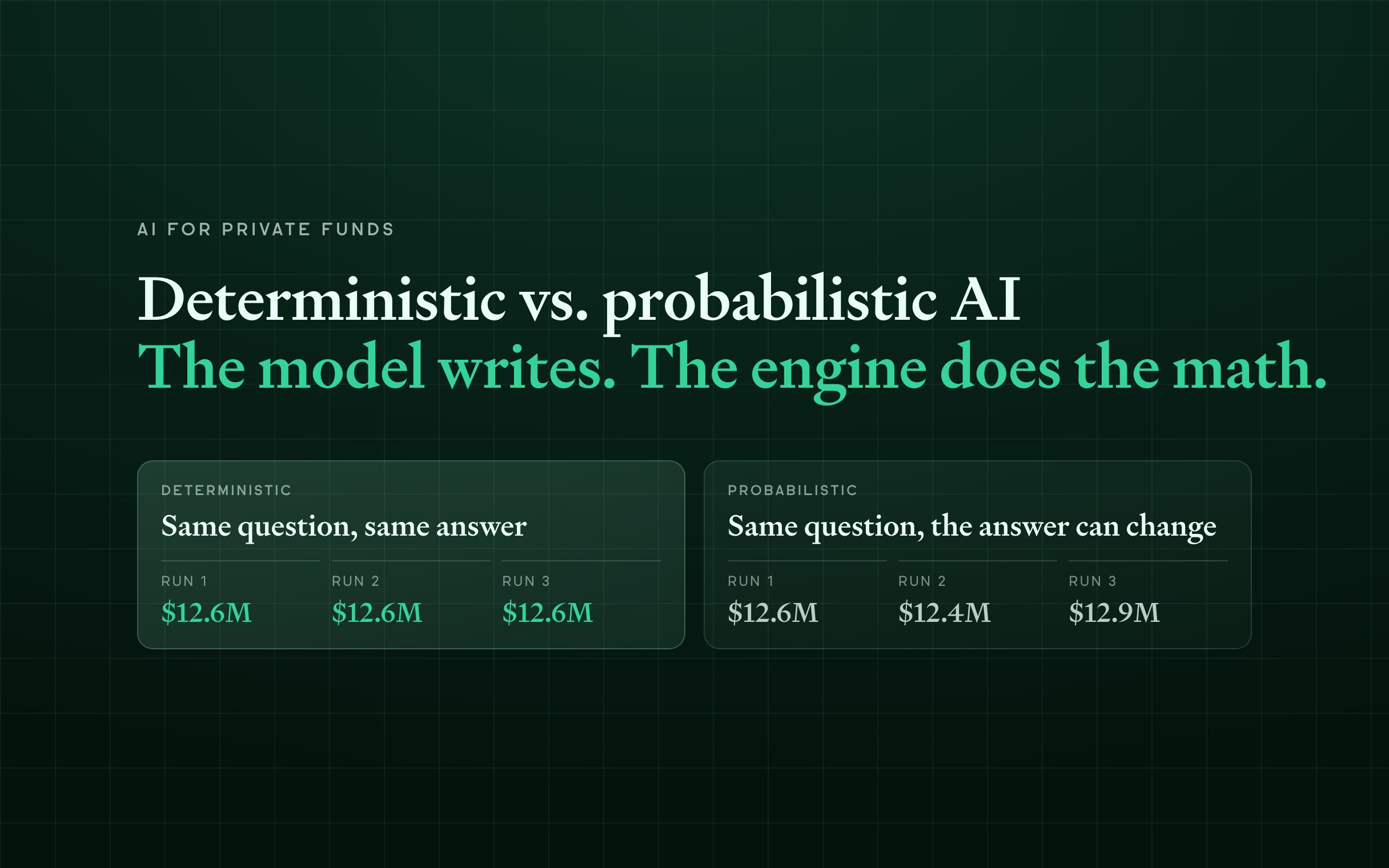
Deterministic AI gives the same answer to the same question every time. Probabilistic AI can give a different answer even when the question stays the same.
A fund needs both. A probabilistic model is good at the words: the investor letter, the notice, the answer to a question about the terms. A deterministic engine has to produce the numbers inside them.
What is deterministic vs. probabilistic AI?
A deterministic system returns the same output from the same inputs under fixed rules. A probabilistic system builds each output from likelihoods, so two runs of the same question can return two different answers, both plausible.
Large language models are probabilistic. Fund calculations have to be deterministic, because a capital call notice, the administrator's file and the audit workpaper must all show one figure.
How do a writer and a calculator show the difference?
A good writer asked for the same paragraph twice gives you two different paragraphs, both good. A calculator asked for the same sum twice gives you the same number, or it is broken.
A letter to investors can change from draft to draft. The carry figure in that letter cannot.
Video transcript
Deterministic means the same question gets the same answer. Every time. Probabilistic means that the answer can change, even when the question stays the same. AI models are probabilistic. That is by design. It is what makes them so good with language. Ask a great writer for the same paragraph twice, and you get two good paragraphs. Ask a calculator for the same sum twice, and you need the same number twice. A fund needs both. A letter to your investors can change from draft to draft. The carry in that letter cannot. When an AI model does the math itself, it chooses its method again on each run. One run counts days. The next counts months. The numbers are close, but close is the problem. Now the notice does not tie to your administrator's file, and someone must find out why. So give each part the right job. Maybern is the input. Maybern reads your terms, sets them up as fixed rules, does the math, and answers the question with a source for each number. Your AI tool uses those numbers. It formats them or writes the notice the way your team wants, but it does not change them. Maybern is deterministic. The same inputs give the same answer on every run. And a person approves before anything posts. If your administrator prepares your notices today, Maybern agents can check each one independently with the same engine before it goes out to investors. Your AI tool asks, Maybern calculates.
Why is an AI model probabilistic?
A language model writes one piece of text at a time, choosing among likely next words. That is by design, and it is why models are good with language. They can summarize a limited partnership agreement, draft a notice or answer a question in plain English.
The same property means a model brings no fixed method of its own to a calculation. A model can write code that computes exactly. Unless a rule outside the model fixes the method, the next run can write different code and count differently.
What happens when a model does the fund math?
LP 22 joins the fund at a second close on July 1, 2026, with a $25 million commitment. The fund has charged a management fee of 2.0% a year on committed capital, paid quarterly in advance, since the first close on January 1. LP 22 owes the two quarterly fees it missed, $125,000 each, due January 1 and April 1, plus 8% simple interest from each fee date to the true-up at the close.
- Q1. Fee: $125,000.00. Days to July 1: 181. Interest (actual/365): $4,958.90. Total: $129,958.90
- Q2. Fee: $125,000.00. Days to July 1: 91. Interest (actual/365): $2,493.15. Total: $127,493.15
- Catch-up. Fee: $250,000.00. Interest (actual/365): $7,452.05. Total: $257,452.05
Counting actual days, as the fund's terms specify, gives a management-fee catch-up of $257,452.05. Counting 30-day months (180 and 90 days) gives $5,000 and $2,500 of interest and a catch-up of $257,500.00.
The problem is consistency. If the method can change from run to run, two LPs closing on the same day on the same terms can be charged differently, by $47.95 here and by more on a larger commitment. The notices stop tying to the administrator's calculation, and someone has to find out why. If a notice has already gone out, it has to be corrected and reissued.
Where does Maybern fit?
Maybern sets your fund terms up as fixed rules, including the fee rate, the interest method and the day count. Its calculation engine does the math and answers with a source for each number. At a subsequent close, it catches the new investor up on each prior fee period, with interest from each fee date to the true-up.
Your AI tool uses those numbers. It can format a report, explain a calculation or draft the notice the way your team wants. A person approves before anything posts. The same inputs give the same answer on every run, whichever tool asks.
How can an agent check notices your administrator prepares?
Maybern is the operating system for agentic fund management, where a deterministic engine does the fund math and agents do the work around it. Checking notices is one of those jobs. If your administrator prepares capital call and distribution notices, that arrangement stays in place. Maybern agents can recalculate each one from your fund's terms before it goes out to investors. This is a second, independent calculation, and each difference goes to your team to resolve with the administrator.
What does this mean for technology teams?
Lowering a model's temperature reduces variation. It doesn't guarantee identical outputs across runs or model versions, and it doesn't fix the calculation method. The reliable pattern is tool calling: the model asks a calculation engine for the number, the engine returns it with its inputs, and each booked fee keeps the inputs and the rule that produced it.
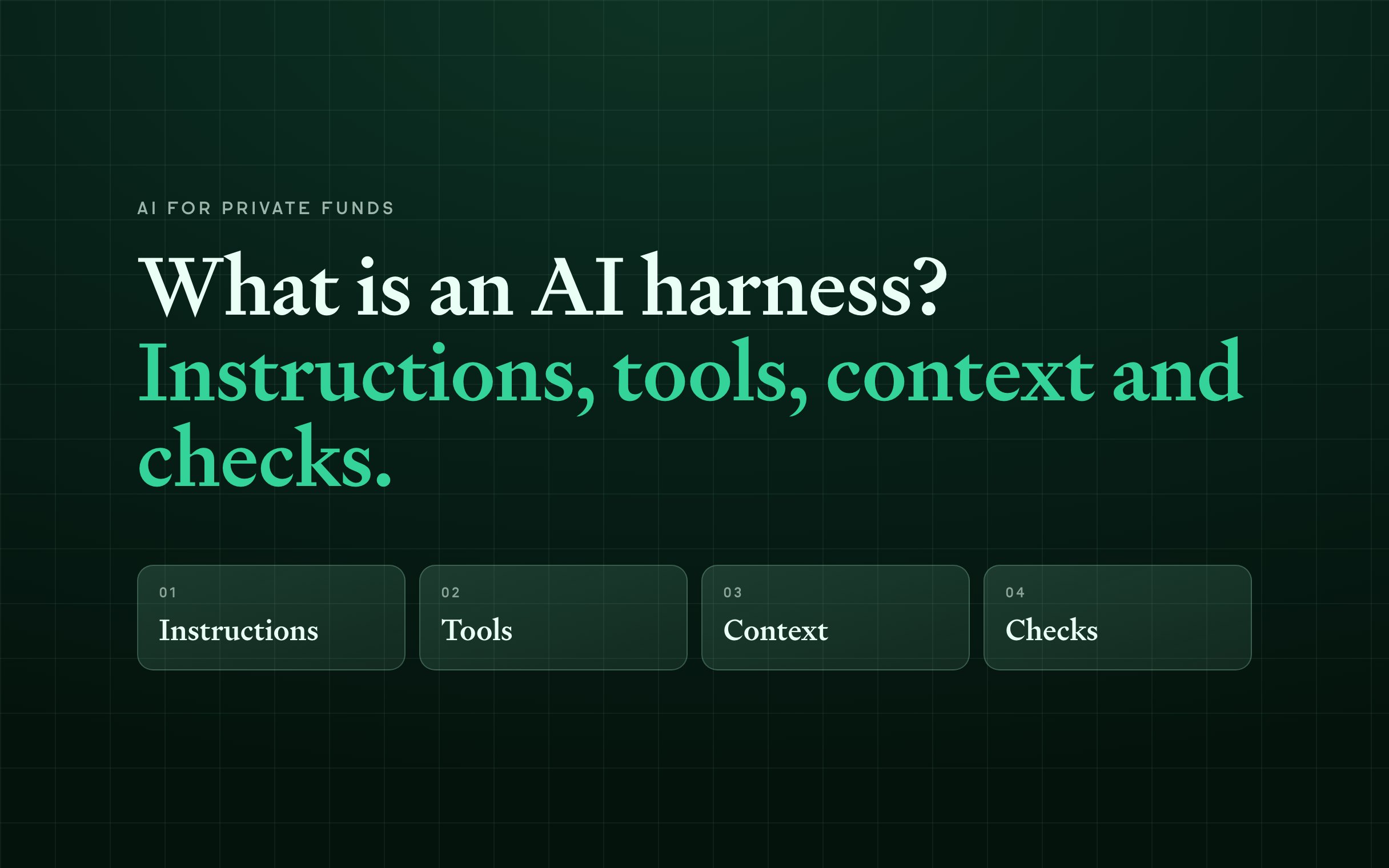
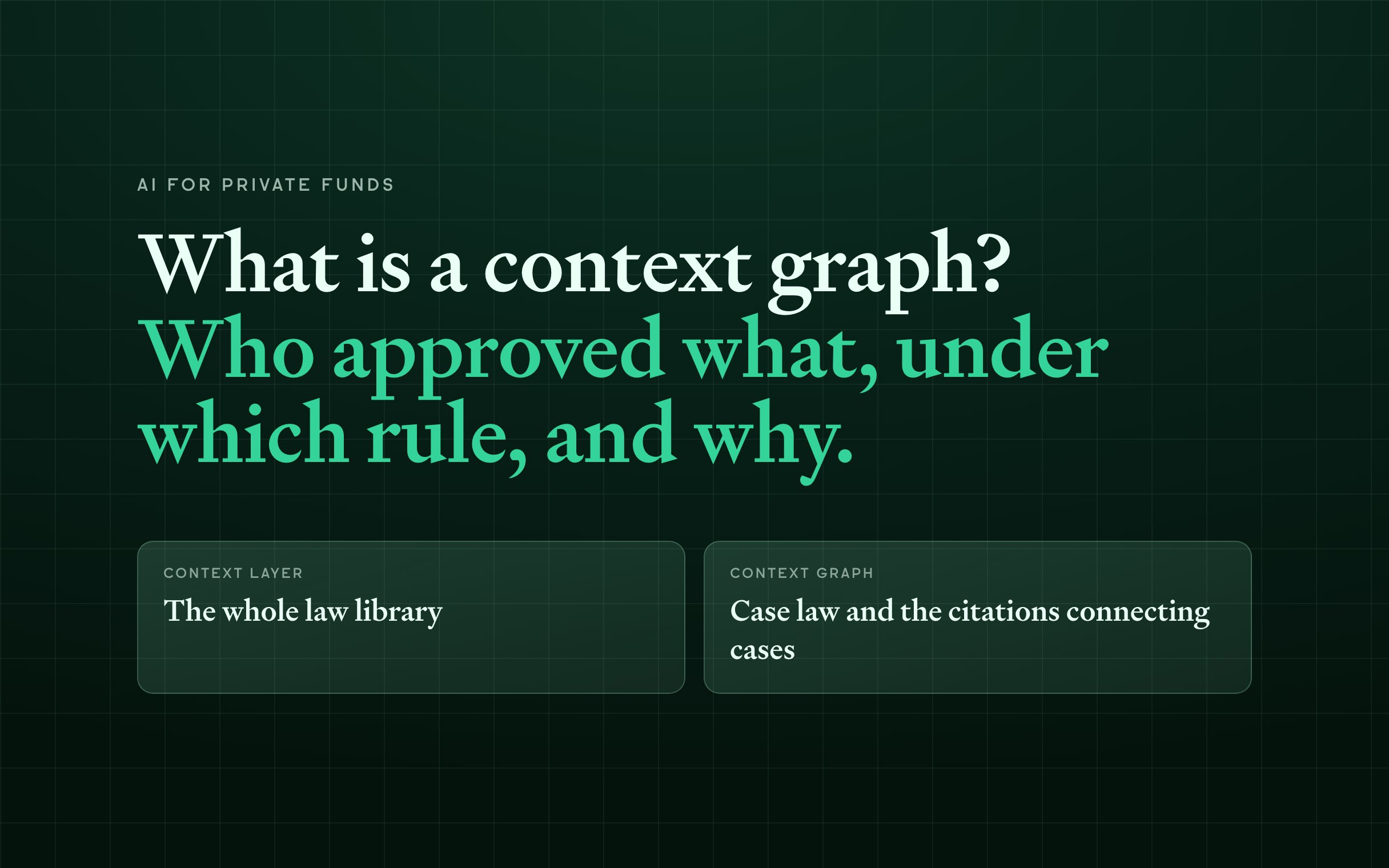
An AI harness is everything around a model that gives it instructions, tools, context and checks, and a calculation engine is one of its tools. Earlier posts in this series cover what an AI tool can see when it answers and how a context graph connects decisions over time. The reference architecture shows how Maybern's results flow back into the firm's own data warehouse.
Deterministic vs. probabilistic AI, in three points
- Language models vary from run to run by design. Lowering temperature reduces the variation but does not fix the calculation method.
- In the illustrative LP 22 example, counting actual days gives $257,452.05 and counting 30-day months gives $257,500.00. If the method can change between runs, two LPs closing on the same terms can be charged differently.
- Maybern sets fund terms up as fixed rules and calculates. Your AI tool asks for the numbers and writes around them, and a person approves before anything posts.
Next in AI for Private Funds: tool calling.
Frequently asked questions
Quick reference for this topic.
01Are LLMs deterministic?
Not reliably by default. A large language model generates text from probabilities over tokens, which are pieces of text. Depending on the model and its settings, generation may involve sampling. Where temperature controls are available, lower settings can reduce variation, but temperature zero does not guarantee identical responses from hosted services. A change of model version is also a change to the system, not a test of the same configuration.
02Can AI do math?
Yes. An AI tool can run code that calculates the result. If the model generates a new calculation for each request, the method can vary. If it calls the same validated code with the same inputs and fixed rules, that calculation can be repeatable. In Maybern, the model asks the calculation engine for the fee catch-up. The engine applies the configured interest method and day count.
03What is deterministic AI?
Deterministic AI describes a system or component that returns the same output from the same inputs under fixed rules. In a fund workflow, a calculation engine provides that component. Its rules still need to reflect the fund's terms, and the inputs still need review. Repeatability does not establish that the method is appropriate.
04Can an AI agent check notices my administrator prepares?
Yes, as a second, independent calculation. Maybern agents can recalculate each notice from your fund's terms before it goes to investors, and each difference goes to your team to resolve with the administrator. The administrator still prepares the notices, and your team approves before anything is sent.
05Where does AI help in fund finance, then?
AI tools can read fund documents and draft notices using the calculation engine's results. They can also answer questions about the terms and supporting records available to them. In Maybern, your AI tool asks the engine for the calculation. A person approves before anything posts.
Recommended Content
What Is an AI Harness? A Private Funds Explainer
What Is a Context Graph? A Private Funds Explainer
What Is Context in AI? A Private Funds Explainer
