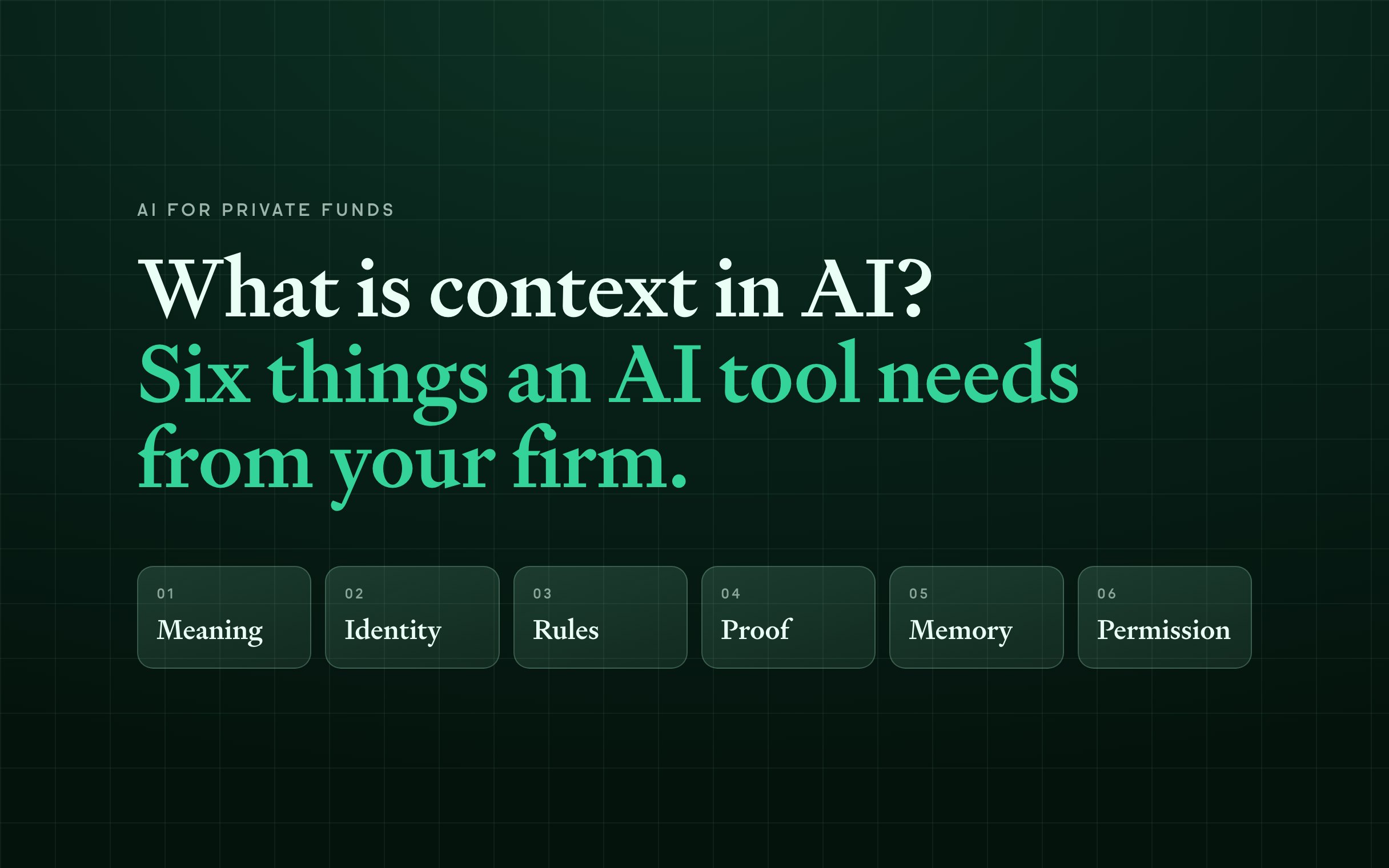
What Is Context in AI? A Private Funds Explainer

What is context in AI, and why does it matter for private funds?
Context in AI is the information available to a model when it answers a question, beyond what it learned during training. For private funds, that includes transaction data and the firm’s reporting conventions, investor mappings, operating procedures, calculation records, decision history and access permissions.
An AI tool can retrieve the right fund records and still return an answer based on conventions the firm does not use.
What is context in AI?
Training gives a model general knowledge. Context supplies the information relevant to a particular question, including instructions, the conversation so far and material provided through documents or connected systems. A model may understand net IRR from training, but it needs your firm’s reporting convention to determine which result to report to LPs.
Context engineering is the work of selecting and supplying the information a model needs to answer reliably. For a fund, this means making the finance team’s conventions explicit and ensuring the relevant records are available when the tool needs them. The systems providing those records must enforce the firm’s access permissions.
Why does a capable AI tool get a fund question wrong?
Fund III used a subscription credit line to fund investments before calling capital from LPs. In this illustrative example, net IRR is 21.7% with the facility and 18.4% without it. ILPA recommends disclosing both measures. To select the appropriate result, an AI tool needs the reporting convention that applies to the report being prepared.
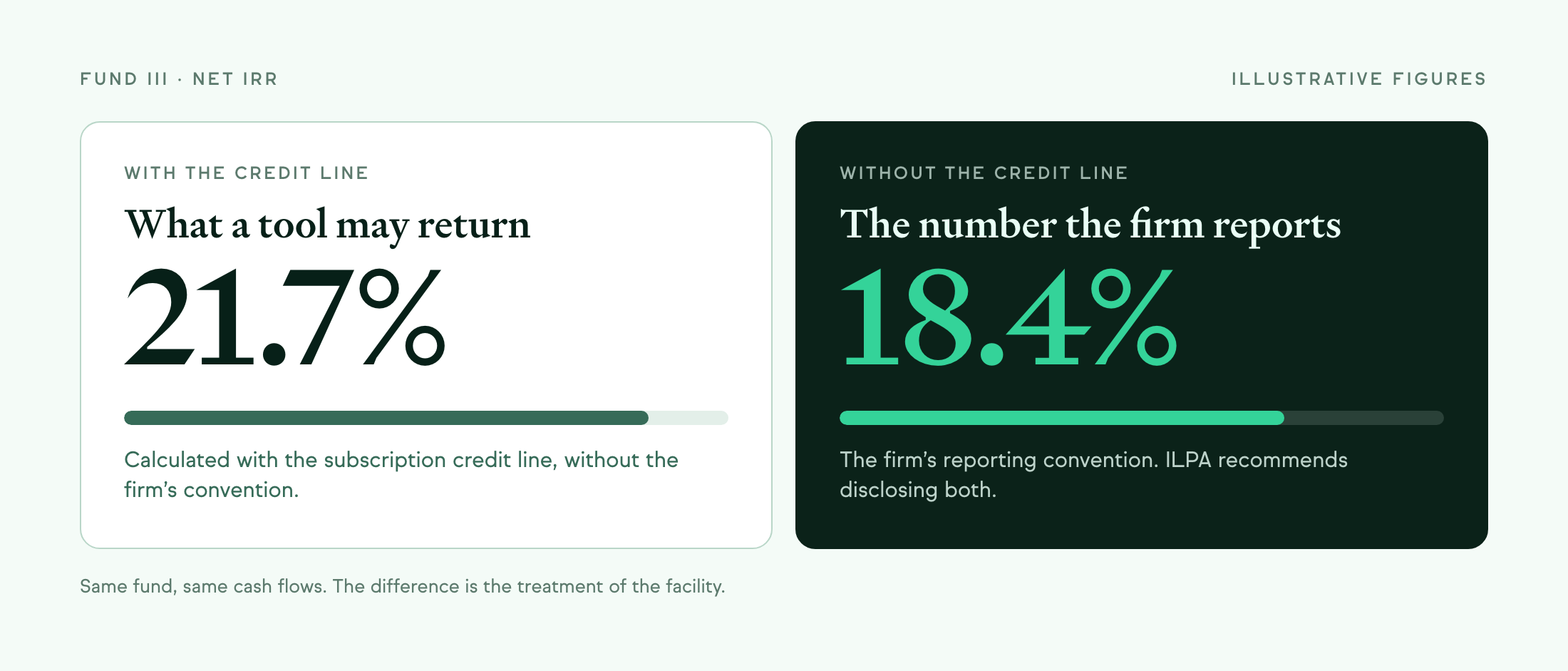
A more capable model still needs the firm’s reporting convention to select the appropriate result.
What are the six things an AI tool needs from your firm?
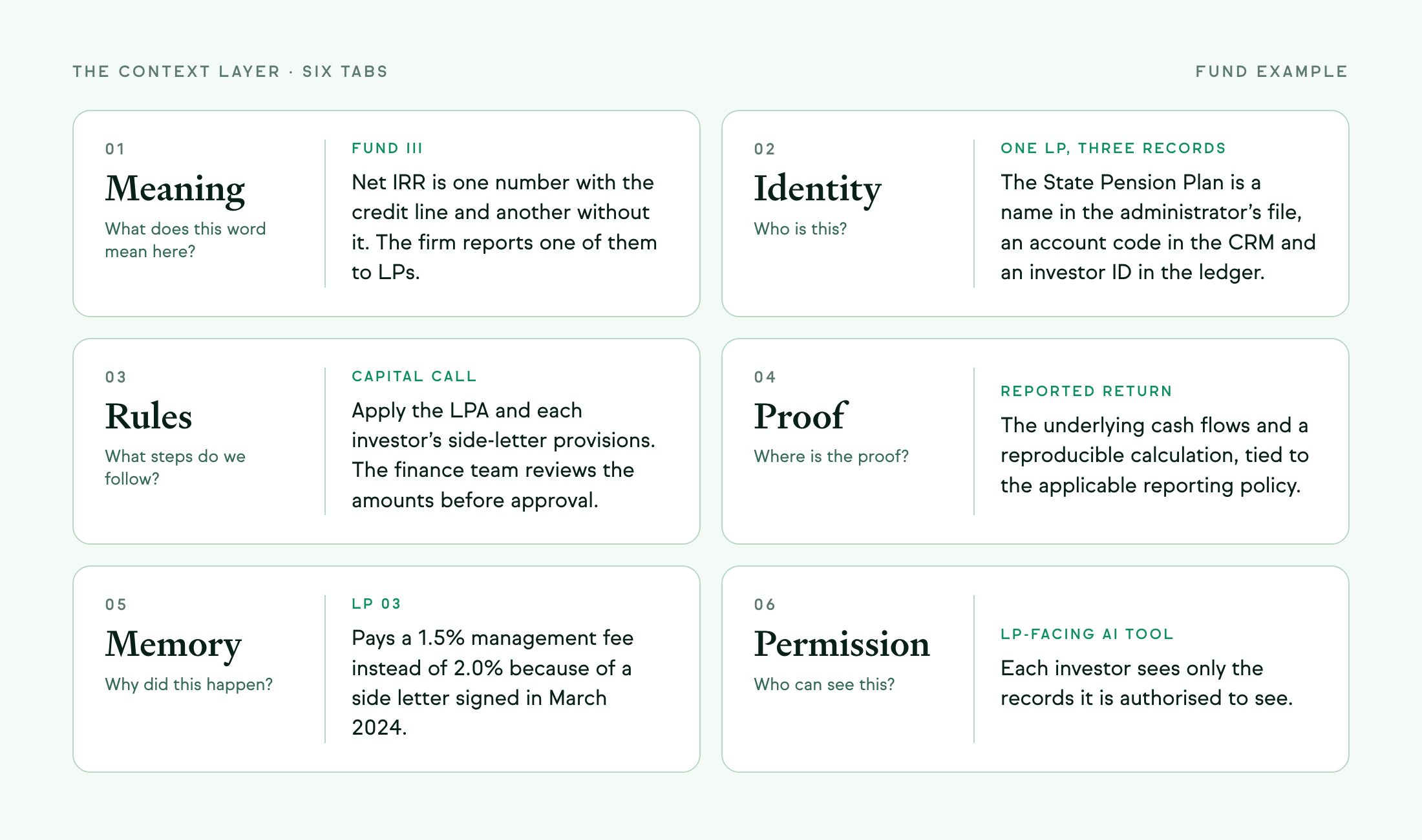
A finance team may rely on conventions and decisions that have never been formally documented. A context layer serves as a binder for AI, organising that knowledge into six tabs. The connected systems enforce the firm’s access permissions and execute its workflows.
Meaning: what does this word mean here?
“Football” means one game in London and another in Dallas. Net IRR can likewise refer to a return calculated with or without the credit line. An AI tool needs the firm’s definitions and reporting conventions to distinguish between them.
Identity: who is this?
The same investor may have different identifiers across your systems. The State Pension Plan might appear by name in the administrator’s file, by account code in the CRM and by investor ID in the ledger. An AI tool needs to recognise these as records of the same LP.
Rules: what steps do we follow?
A capital call follows a defined process, much like a pilot’s preflight checklist. The calculation must apply the LPA and the side-letter provisions relevant to each investor. The finance team then reviews the amounts before approving the call.
Proof: where is the proof?
An LP or auditor needs to trace a reported return to the underlying cash flows and understand the method used. The supporting record should make the calculation reproducible and identify the applicable reporting policy.
Memory: why did this happen?
A ship’s log records why the course changed. A fund needs a comparable record of decisions and changes to its terms. If LP 03 pays a management fee of 1.5% rather than 2.0%, the record should identify the side letter establishing that rate and when it took effect.
Permission: who can see this?
A hotel key limits a guest’s access to designated rooms. An LP-facing AI tool needs equivalent boundaries, restricting each investor’s access to the records they are authorised to see.
Video transcript
Think about a new analyst on their first day. They know finance and they work fast. You ask for the net IRR of a fund. You get a fast answer. The answer is wrong. The analyst does not know your firm yet. AI has the same problem. It is capable, but it does not have the context. Context is what your team knows that is not in the data. Snowflake calls it the limit for AI. Without the right context, the answers are wrong. A good firm gives a new analyst a binder. A context layer is that binder for AI. Meaning, a football in London is not a football in Dallas. Net IRR can also mean two things. Identity, your phone shows one friend under three names. Your systems do this to investors. Rules, a pilot uses a checklist and does not guess. A capital call has a checklist too. Proof, your teacher wanted to see your work. Your auditor wants the source of each number. Memory, a ship's log tells why the course changed. A side letter tells why an LP pays less. Permission, a hotel key opens only your room. One LP must never see the account of another. For the data in your funds, Maybern is this binder. Each LPA term becomes a rule. Each number shows its source. You control which people and agents can read it. Your AI tools, like Claude, read these numbers. Same analyst, same question. Now the answer is correct and it shows its work.
Does a bigger context window fix missing context?
No. A context window is the amount of information a model can work with at once. A larger window can accommodate a long LPA or a full year of capital activity, but it cannot supply a reporting convention missing from the information provided.
How does context reach an AI tool?
Context reaches an AI tool through the conversation and the systems it can access. A reporting policy might be attached to a message or retrieved from the firm’s records. In either case, the relevant information must be available to the model when it answers.
Snowflake’s March 2026 article, The Agent Context Layer for Trustworthy Data Agents, describes how a context layer supplies the business meaning and operational history an agent needs to answer enterprise questions.
Maybern’s Model Context Protocol (MCP) connection lets users ask fund questions through Claude, ChatGPT or Copilot, subject to their Maybern permissions. Maybern calculates the figures, and each answer shows its date, method and inputs. The AI tool reads the numbers without changing them. See the Maybern MCP and reference architecture.
AI context for private funds, in five points
- Context in AI is the information available to a model when it answers a question, beyond what it learned during training. For private funds, that includes data and the firm-specific knowledge needed to interpret it.
- An AI tool needs the firm’s reporting convention to distinguish between Fund III’s net IRR of 21.7% with the credit line and 18.4% without it. These figures are illustrative.
- The six tabs of a fund’s context layer are meaning, identity, rules, proof, memory and permission.
- A larger context window accommodates more information. It cannot supply a reporting convention missing from the material provided.
- A system connection makes information accessible to an AI tool. The relevant information must reach the model’s context to inform its answer.
Next in AI for Private Funds: the context graph.
Frequently asked questions
Quick reference for this topic.
01Does a bigger context window fix missing context?
No. A context window sets how much information a model can work with at once. A larger window can't supply a reporting convention that the tool was never given.
02Is context the same as our data?
Data is one part of context. A fund question may also require your firm's reporting conventions or the records explaining an investor's fee terms. For example, the tool needs to know which net IRR the firm reports and why an LP pays a lower fee.
03Can an AI tool read files from an unconnected system?
A tool needs a way to access the file, such as an upload or a connection to the system that holds it. The tools available and the permissions enforced by those systems determine what it can read.
04Does complete context guarantee a correct answer?
No. A fund calculation engine applies fixed rules to its inputs, but the method must still be correct and a person must review the result. A person should approve any proposed transaction before it posts.
05
Recommended Content

Shipped in Maybern: a fund agent, MCP and reconciliation
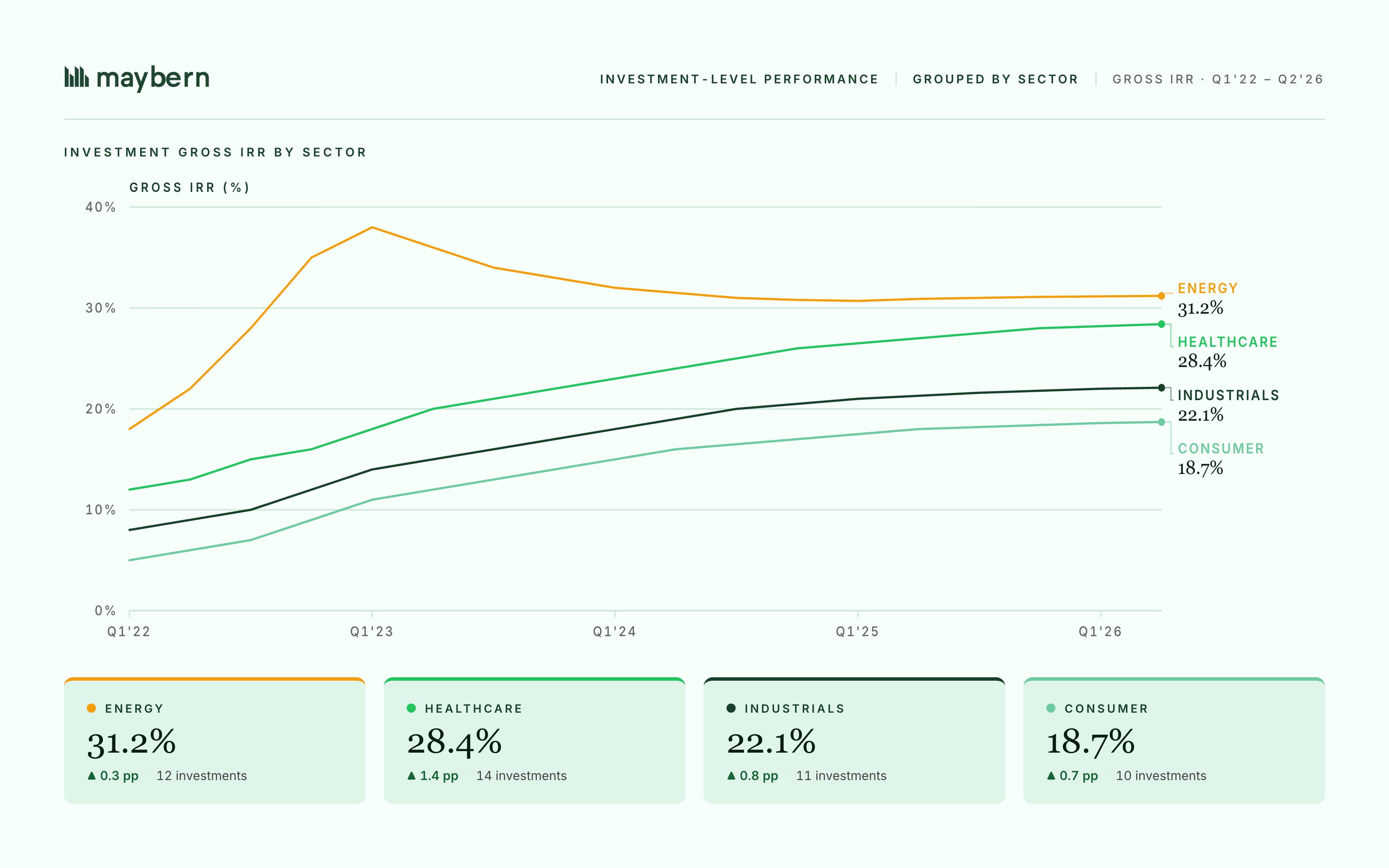
Deal-Level Performance, From the Same System as Your Fund-Level Numbers