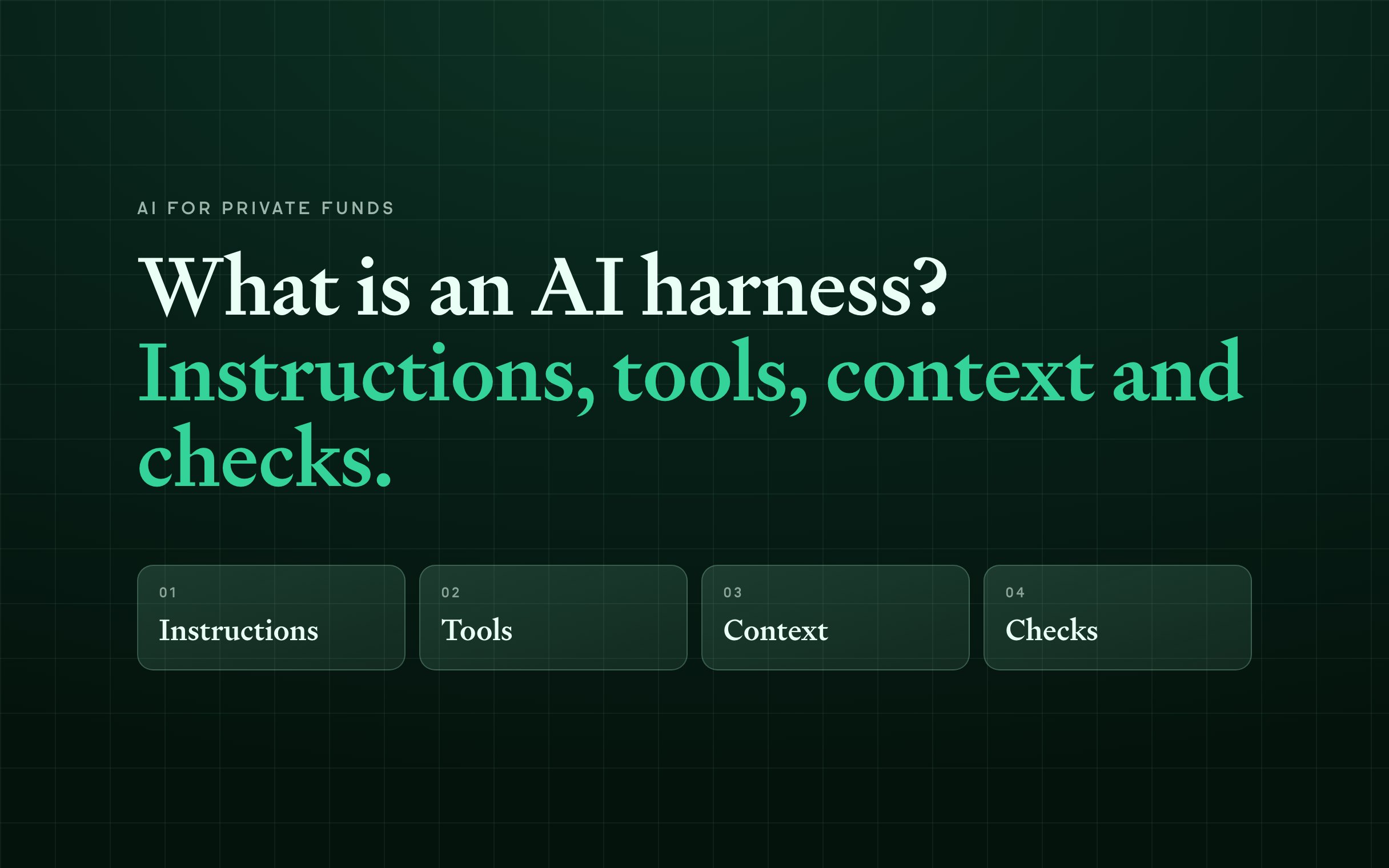
What Is an AI Harness? A Private Funds Explainer

What is an AI harness, and why does it matter for private funds?
An AI harness is everything around a model that gives it instructions, tools, context and checks so it can perform a task. In a private fund, an agent harness connects the model to fund terms and a calculation engine, with sources and human approval required before a result posts.
Your controller gets the fee with its source attached, and nothing posts until someone on the team approves it.
What are the four parts of an AI harness?
The model reads the request. The harness tells it what the job is, gives it the documents and systems it needs, and decides what has to happen before its work counts.

- Instructions. What it does: Tell the model the job. In a fund: “Calculate this LP's management fee”
- Tools. What it does: Let it act. In a fund: Run the calculation in a system built for it
- Context. What it does: Give it the facts. In a fund: The LPA, side letters, cash flows
- Checks. What it does: Stop mistakes before they land. In a fund: Show the source, wait for team approval
In the LP 14 case, the instruction is the fee question, the side letter is the context, the calculation engine is the tool and the controller's approval is the check.
Why is it called a harness?
The word comes from horses. A horse has strength, but a harness connects that strength to a cart and lets the driver steer it.
An AI model is powerful in the same way. On its own, it can't see the fund's data, use its systems or check a result against the fund's records.
Video transcript
Everyone talks about AI models. But the model is only half of the answer. The other half is the harness. The word comes from horses. A horse is strong. But without a harness, it cannot pull a cart, and you cannot steer it. An AI model is the same. It is powerful. But on its own, it cannot see your data, use your systems, or check its work. The harness is everything around the model. Instructions tell it the job. Tools let it act. Context gives it the facts. And checks stop it before it makes a mistake. Same model, different harness, very different results. In a fund, this matters. Ask a model alone for the fees on one LP, and it guesses. Put it in a harness, and it reads the fee terms from the side letter, runs the calculation in a system built for it, shows the source, and waits for your team to approve. Maybern builds that harness for fund operations. Your fund terms become rules. One engine calculates each number. And agents work inside those rules, with your team in control. Maybern. Get the harness right.
Why can the same model give different results?
“Same model, different harness, very different results.” What the model can answer depends on what it can see, what it can call and what has to approve the result. Without LP 14's side letter it falls back on what fees usually are, and 1.5% is a plausible wrong answer. With clause 4 it has the rate, and with the engine it never does the arithmetic itself.
What does a harness look like in a fund?
“What management fee does LP 14 pay?”
In this illustrative example, a model alone guesses “1.5%?” In a harness, it reads clause 4 of LP 14's side letter, which sets a 1.25% annual management fee on a $3.3M commitment.
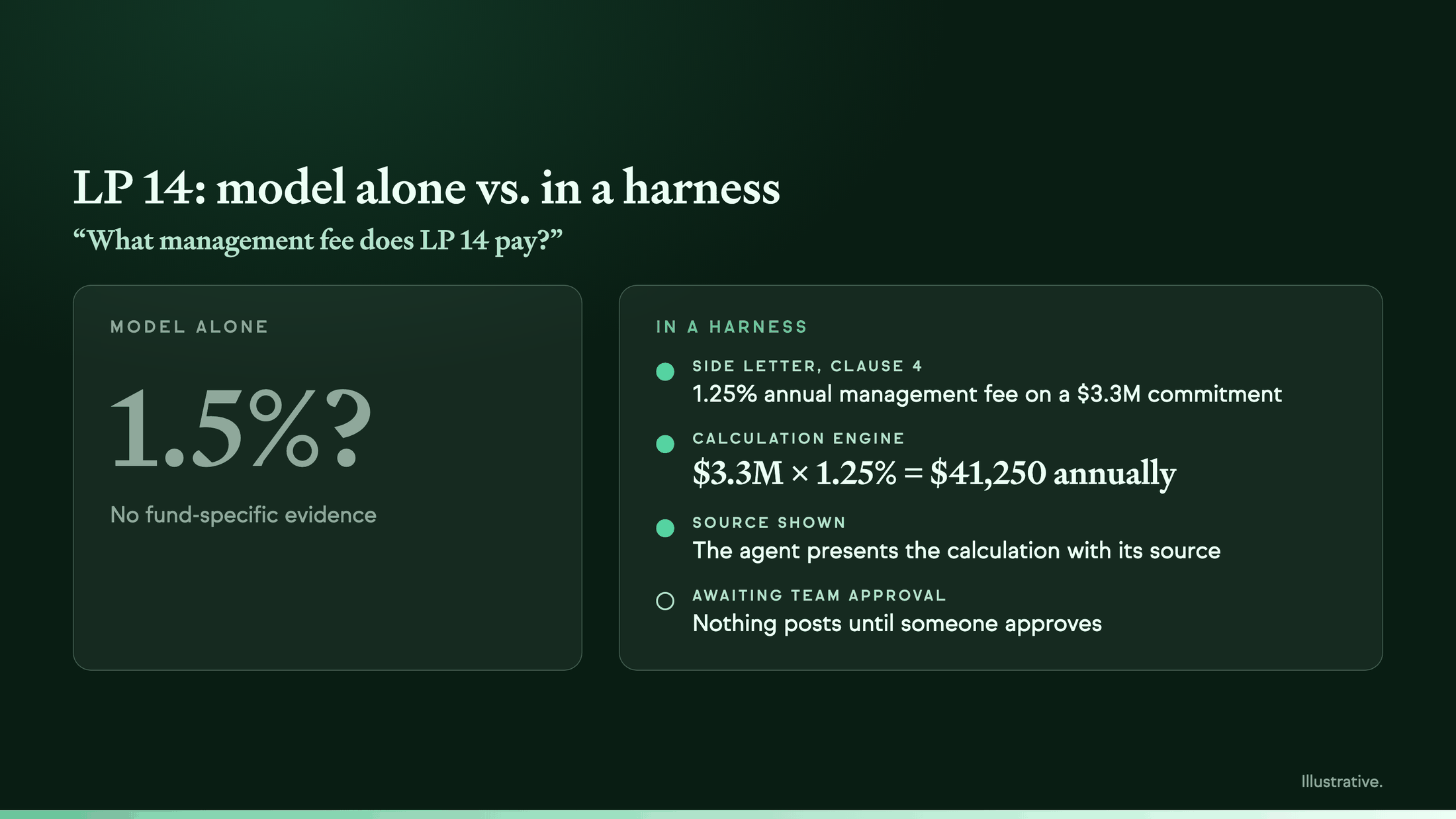
The model calls a calculation engine. The engine applies the configured fee rule:
$3.3M × 1.25% = $41,250 annually.
The model does not do the math. Billed quarterly, that is $10,312.50 a quarter. The agent presents the calculation with its source and waits for the team to approve.
The controller can review the rate against clause 4 and confirm the commitment used as the fee basis. Each posting needs its own approval, so next quarter's fee comes back to the controller with its own source.
How does a harness relate to context and a context graph?
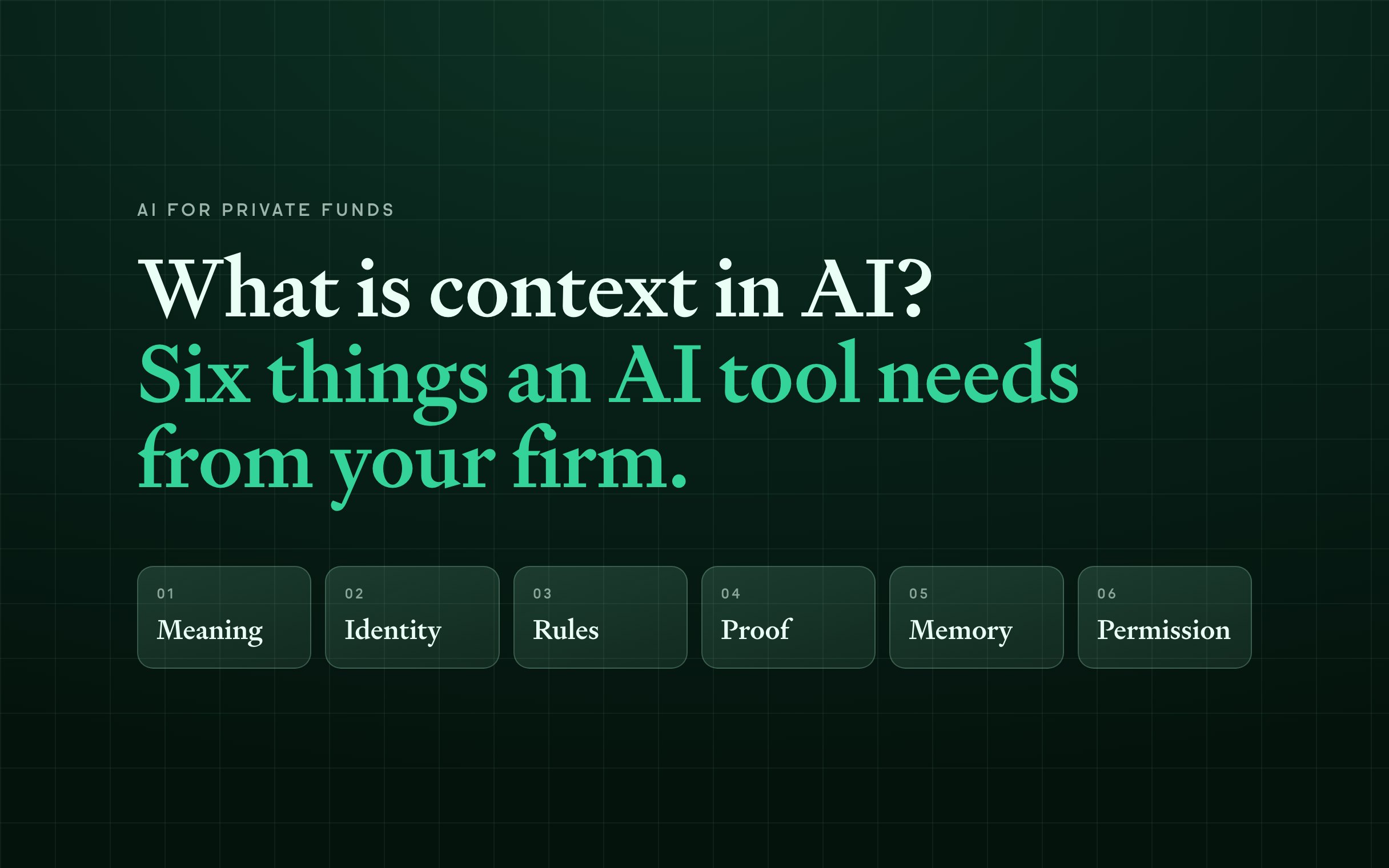
Context is the information available to an AI tool when it answers. It is one part of the harness. Context supplies the facts, while tools let the model request calculations or perform other permitted actions.
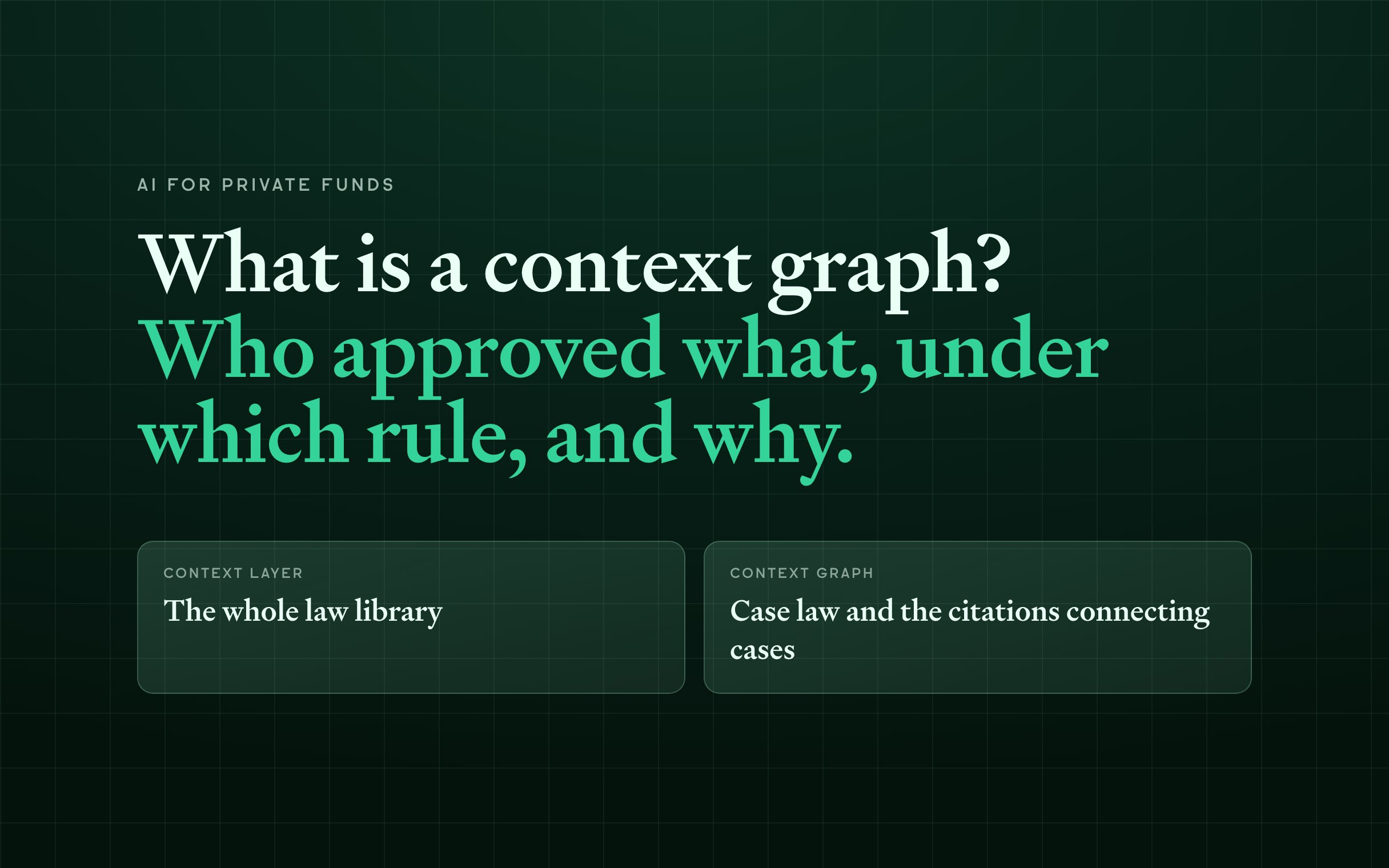
A context graph is the connected record of decisions behind those numbers: who approved what, under which rule and why. A harness reads that record before an agent acts, and each approval adds to it.
Where does Maybern fit?
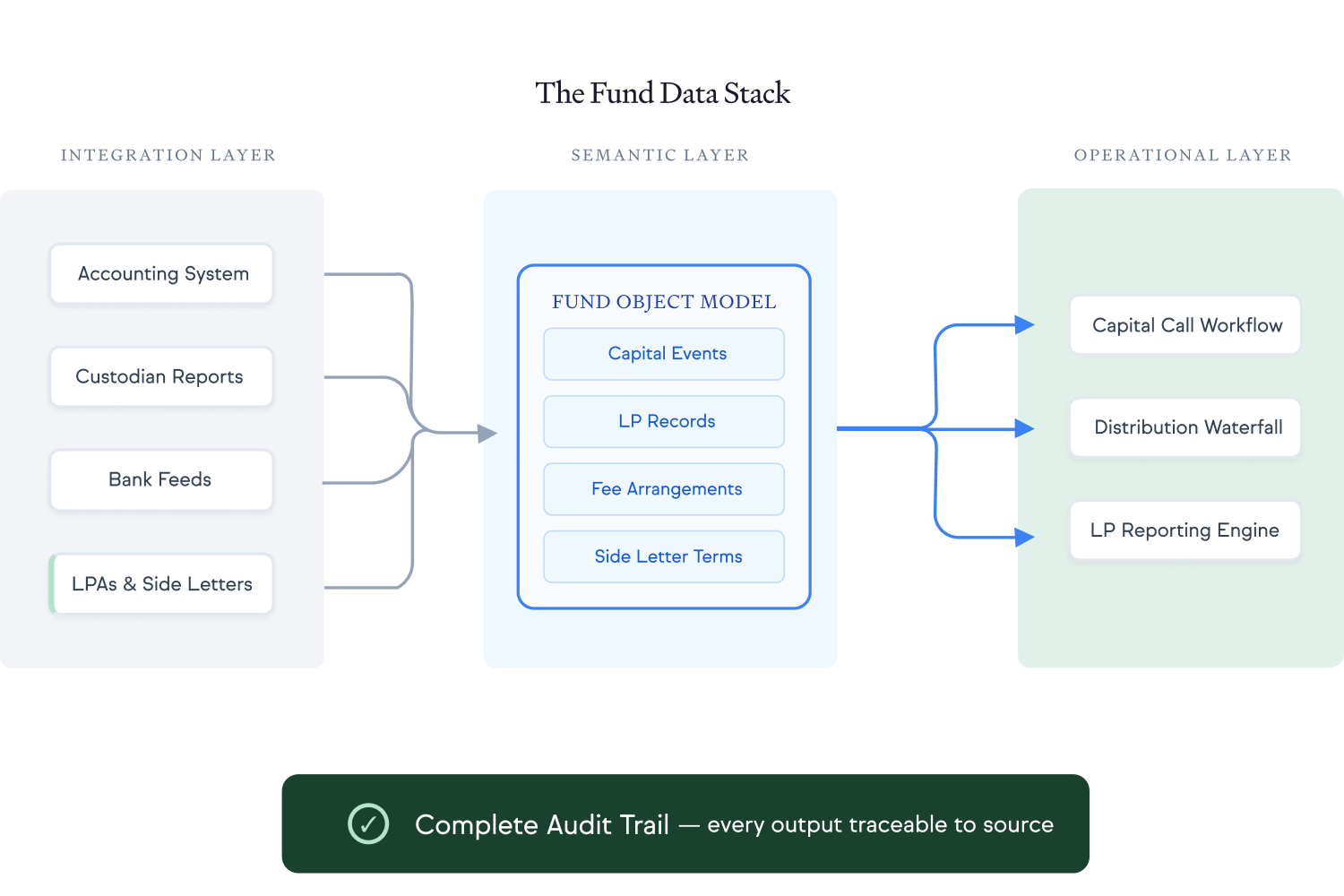
Maybern encodes LPA terms as rules, applies them to transactions and maintains the firm's calculated fund record. A side-letter rate, like LP 14's 1.25%, is set on that investor's commitment. One engine calculates each result and links it to its source.
The fund record supplies the rules and calculation engine, with an approval step before posting. Maybern's agents work inside those controls. Nothing posts until a person approves, and agent actions are logged.
Your AI tool connects to the fund record through the Maybern MCP, or Model Context Protocol. It requests calculations from the engine and receives results with their sources. Your controller reviews the same numbers, from the same fund record, that your AI tool used.
What should technology teams know about an AI agent harness?
Instructions can take the form of a system prompt. Tools can be defined functions or MCP tools, with context drawn from the fund record. Permissions govern available actions. Approval gates control posting, and an action log records what the agent did.
The work of configuring and testing these components is often called harness engineering. The reference architecture shows how Maybern's results and sources reach the firm's own Snowflake account.
AI harnesses for private funds, in five points
- An AI harness supplies instructions, tools, context and checks around a model.
- Give a model LP 14's side letter and it has the rate. Without it, the model guesses.
- A calculation engine applies fund rules to transactions. The model requests the calculation.
- A proposed fee needs its source and team approval before posting.
- In Maybern, the rules, the engine and the approval step come from the fund record, and agents work inside them.
Next in AI for Private Funds: tool calling.
Frequently asked questions
Quick reference for this topic.
01Is the model or the harness more important?
For a fund question, the harness decides more. On its own, a model guesses 1.5% for LP 14. In a harness, the same model reads clause 4 and gets a $41,250 calculation from the engine. The harness also holds the result for a person's approval before anything posts.
02What is the difference between an AI harness and an AI agent?
An AI agent uses a model and tools to carry out a task. The harness is the surrounding structure that supplies its instructions, context and controls. It defines what the agent can use and when work requires approval.
03Can a general AI tool calculate fund fees?
Yes, if it is connected to the fee terms and a calculation engine. Without them, any model is estimating. For a fund fee, the rate should come from the side letter and the arithmetic from an engine. The result goes to a person for approval with its source attached.
04What checks should a fund require before an AI result posts?
The reviewer should confirm the applicable terms and calculation inputs, including the effective date. The result should link to its source and calculation method. A person must approve before posting, and the workflow should log the agent's actions.
05
Recommended Content
What Is a Context Graph? A Private Funds Explainer
What Is Context in AI? A Private Funds Explainer
How Agentic AI Is Redefining the Fund CFO
