What Is a Context Graph? A Private Funds Explainer

What is a context graph, and why does it matter for private funds?
A context graph is a connected record of decisions that links people and accounts over time, showing who approved what, under which rule, and why.
For a private fund, a context graph can link a side-letter provision to a fee calculation and the controller's approval. The graph builds on a context layer, which holds the definitions, rules, sources and permissions an AI agent needs to answer a fund question.
What is a context graph?
A fee record may show the approved rate without explaining how the firm applied a side letter or resolved an exception. The explanation may be recorded in email or known only to the people who made the decision.
A context graph links decisions to their supporting evidence. Foundation Capital's December 2025 essay, AI's trillion-dollar opportunity: Context graphs, uses the term decision traces for records of how people applied rules and approved exceptions. The graph links decisions over time to the people and accounts involved, so a reviewer can find an earlier decision and the reason for it.
Context layer vs. context graph
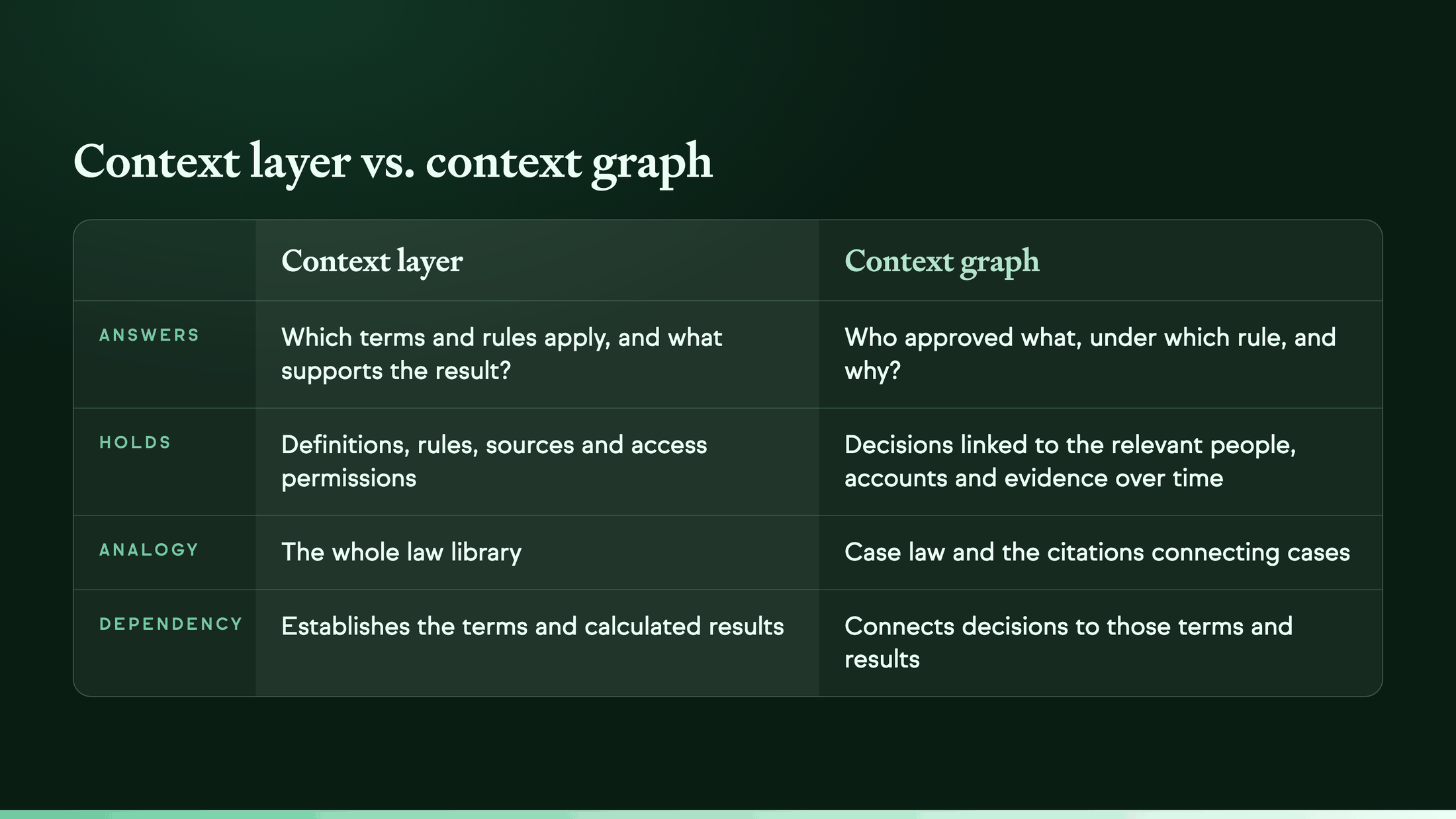
- What each answers. Context layer: which terms and rules apply, and what supports the result? Context graph: who approved what, under which rule, and why?
- What each holds. Context layer: definitions, rules, sources and access permissions. Context graph: decisions linked to the relevant people, accounts and evidence over time.
- Analogy. Context layer: the whole law library. Context graph: case law and the citations connecting cases.
- Dependency. Context layer: establishes the terms and calculated results. Context graph: connects decisions to those terms and results.
How does a law library explain the difference?
In this analogy, statutes provide the rules and case law shows how those rules have been interpreted and applied. Citations connect a case to earlier decisions. That network is the graph, while the whole library is the layer.
For a fund, each approval must identify the terms and calculation the controller reviewed. A later reviewer can then assess whether the decision applies to a new calculation.
Video transcript
Context layer, or context graph? Both help an AI agent give the right answer. But they do different jobs. A context layer is everything an agent must know about your business. What each term means, which rules apply, where each number comes from, and who can see it. A context graph is the connected part. It links people, accounts, and decisions over time. It records who approved what, under which rule, and why. Think of a law library. The statutes are the rules. Case law shows how each rule was applied, and each case cites the cases before it. That web of cases is the graph. The whole library is the layer. In a fund, the layer says: this LP has a fee break in its side letter, and here is the calculation. The graph adds: last quarter, the controller approved that fee. Next quarter, an agent can follow that precedent. So which do you need first? The layer. If the numbers under a graph disagree, the graph only remembers the wrong answers, faster. Maybern builds the context layer for the data in your funds. Your fund terms become rules. One engine calculates each number, and each number shows its source. Then each decision your team approves builds on top of it. Maybern. Start with the layer.
What does a context graph look like in a fund?
In an illustrative fund, clause 4 of LP 14's side letter sets its annual management fee rate at 1.25%. The annual fee on a $3.3M commitment is $41,250, billed quarterly. The context layer holds the fee rate and calculation, linked to clause 4 of the side letter.
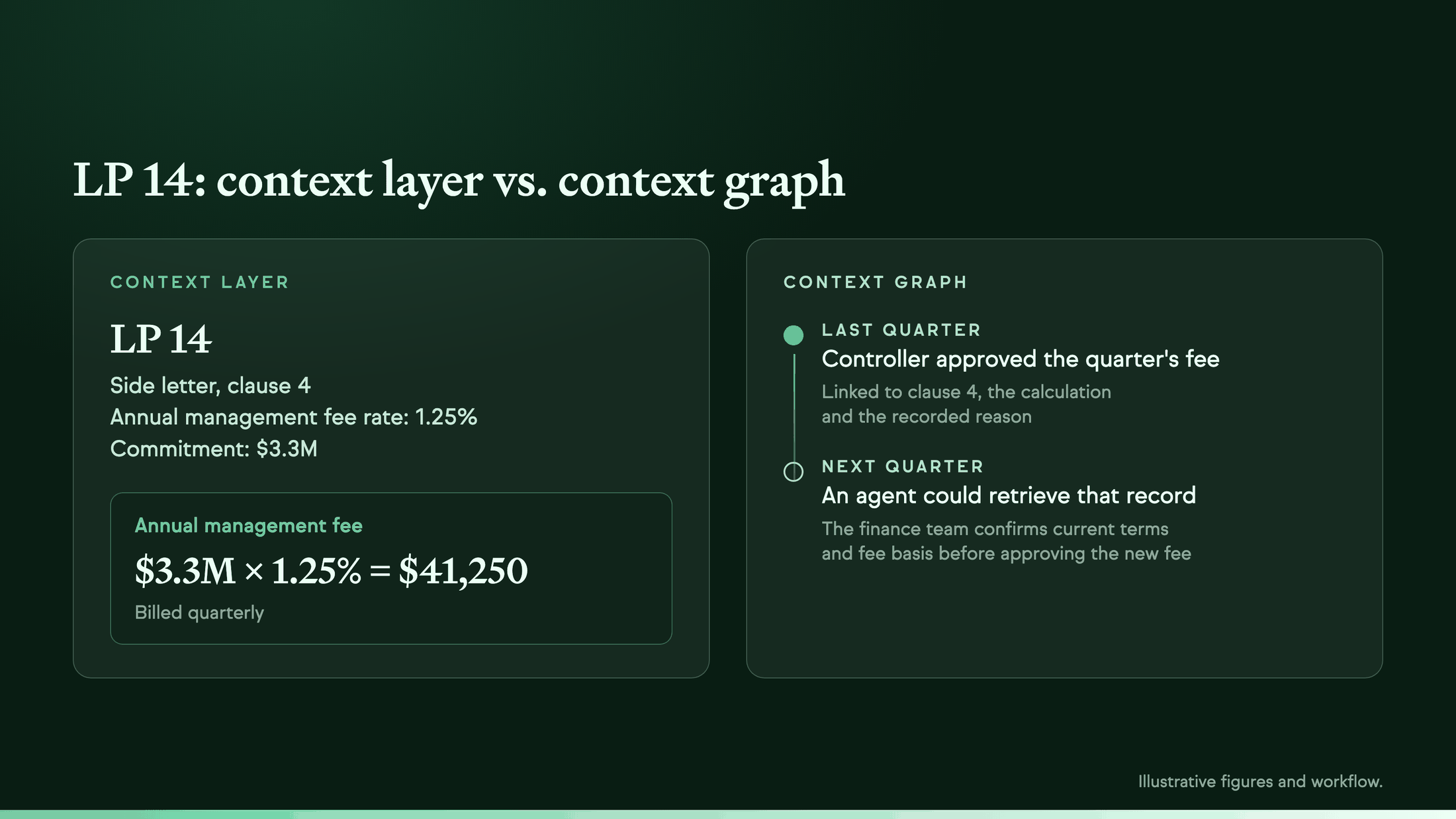
The context graph links the controller's approval last quarter to clause 4 and the calculation reviewed. It also records why the controller approved the fee. An agent using such a graph could retrieve that record when preparing next quarter's fees. The finance team would still need to confirm the current terms and fee basis before approving the new fee.
Why does precedent in a fund need care?
A fee concession to one LP may be relevant to another LP's most-favored-nation (MFN) rights. Whether that investor can elect the term depends on its MFN provision, including any commitment-size thresholds or exclusions for fee concessions.
An agent with access to the context graph could retrieve the earlier decision and the terms that applied. The finance team and counsel must determine whether another investor can elect those terms. The earlier approval alone does not establish that investor's entitlement.
Why does the context layer come first?
Suppose the administrator's file shows LP 14's commitment as $3.5M and the fund model shows $3.3M for the same effective date. At an annual fee rate of 1.25%, the $3.5M commitment produces a fee of $43,750. The $3.3M commitment produces a fee of $41,250. The annual difference is $2,500.
The finance team must reconcile the commitment before approving the fee. Otherwise, a later workflow could reuse an approval based on the wrong amount. The context layer holds the reconciled commitment and fee calculation. The graph links the approval to those records.
Is a context graph the same as a knowledge graph?
A knowledge graph represents entities and their relationships. It can also record history and provenance, including where information came from and how it changed. A context graph focuses on decisions, linking approvals to the applicable rules and evidence. A team can build a context graph using knowledge graph techniques.
What does a context graph need from fund data?
Stable identifiers must connect each decision to the relevant fund and investor commitment, and to the applicable clause. Version history must preserve the terms and calculation reviewed at the time of approval. Effective dates show when the terms applied.
The record must also explain the reason for the decision and link to the evidence the approver used. An action log that records only who acted and when cannot explain why the approver made that decision. These links let a reviewer trace an approval across systems that use different investor identifiers.
Where does Maybern fit?
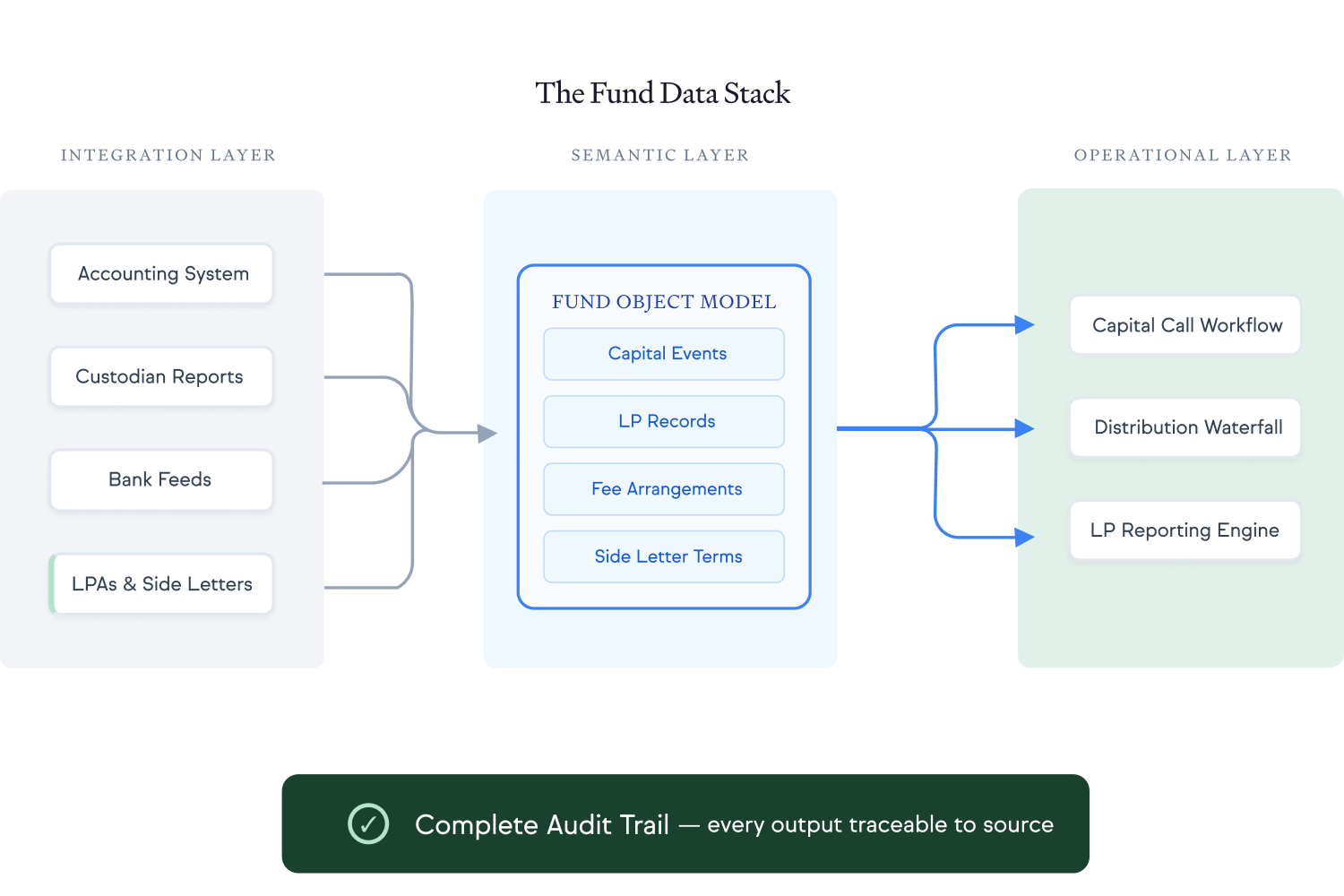
Maybern provides the fund record underlying the context layer. It encodes LPA terms as rules and sets side-letter fee rates for each investor commitment. Its calculation engine applies those rules and links each result to its source. A person must approve each posting, and Maybern logs agent actions. The reference architecture shows how results reach the firm's own Snowflake account alongside its other records.
A fund's context graph starts from these calculations and approval records. The reasons behind each decision are still the firm's to record.
Context graphs for private funds, in five points
- A context graph is a connected record of decisions that links people and accounts over time, showing who approved what, under which rule, and why.
- A context layer holds the applicable definitions, rules, sources and permissions. The graph links decisions to those records.
- In the law library, the whole collection is the layer. Case law and the citations between cases form the graph.
- In the illustrative LP 14 example, a 1.25% annual fee on a $3.3M commitment is $41,250. The graph links the controller's quarterly approval to the relevant clause and calculation.
- The layer comes first. Terms and calculation inputs must be reconciled before an approval can serve as reliable precedent.
Next in AI for Private Funds: deterministic vs. probabilistic.
Frequently asked questions
Quick reference for this topic.
01What is the difference between a context layer and a context graph?
A context layer holds the definitions, rules, sources and permissions an AI agent needs to answer a question. A context graph links decisions to that information over time, recording who approved what, under which rule, and why. The graph builds on the layer.
02Is a context graph the same as a knowledge graph?
A knowledge graph represents entities and their relationships. It can also record history and provenance. A context graph focuses on decisions and the rules and evidence used to make them. A team can build a context graph using knowledge graph techniques.
03Can an AI agent reuse past decisions automatically?
A past approval does not authorize the same treatment in a new period or for another investor. An agent with access to a context graph could retrieve the earlier decision and the terms that applied. The finance team must check the current terms before approving the new calculation.
04Where does a fund's decision history live today?
A fund may keep side letters in its legal files and approvals in email, without a written record of the reason for each decision. A context graph links those decisions to the relevant accounts and calculations. The firm must record the reasons if the graph is to preserve them.
05
Recommended Content
What Is Context in AI? A Private Funds Explainer
How Agentic AI Is Redefining the Fund CFO

Shipped in Maybern: a fund agent, MCP and reconciliation
