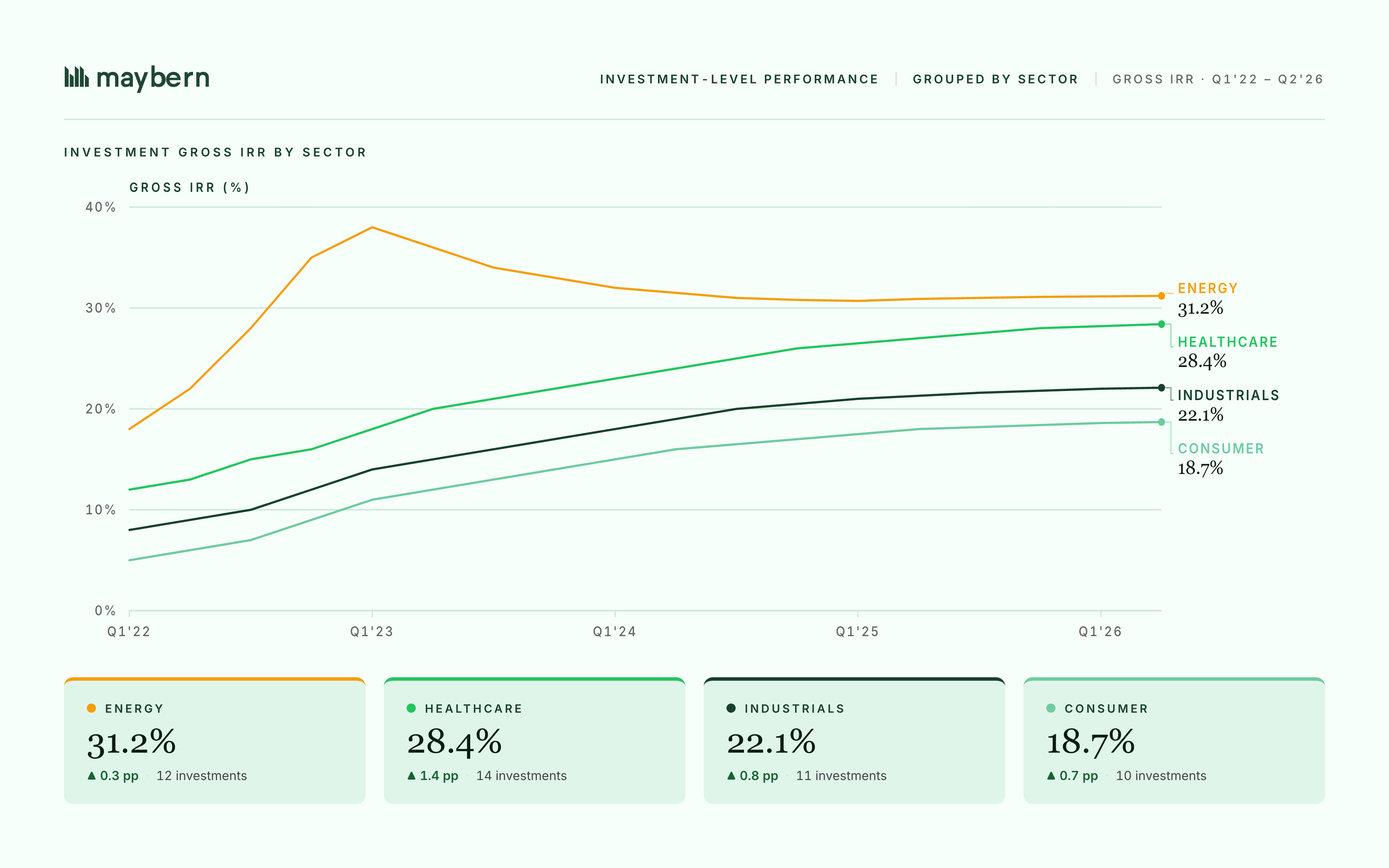
Deal-Level Performance, From the Same System as Your Fund-Level Numbers

Investment-level cashflows now flow through the same allocation engine and audit trail as fund-level activity. Transaction Register makes deal-level performance run from the same governed source of truth as your fund, with flexible inputs, unitization, FX, and custom transaction codes handled out of the box.
- Transaction Register brings investment-level cashflows into the same system, allocation engine, and audit trail as fund-level activity, so deal-level performance runs from one source of truth.
- Capital amounts can be entered at any granularity the source data arrives in: per security, share class, fund, or entity. Maybern handles the allocation.
- Unitization and FX (local currency, amount, conversion rate, and price-per-unit-in-local-currency) are handled out of the box and available to downstream calculations.
- Custom investment transaction codes let a team match its own taxonomy while behaving like native codes for allocation, calculation, and reporting.
- Transaction Register is the foundation for investment activity flowing into fund NAV. On the roadmap: agentic reconciliation against an administrator.
Maybern is already the system of record for fund-level activity: capital calls, distributions, waterfalls, and LP positions. Investment-level activity, the data that drives deal-level performance, has typically lived somewhere else. A separate spreadsheet, a prime broker file, an admin report that has to be reconciled by hand.
Transaction Register closes that gap. Investment cashflows now flow through the same allocation engine, the same audit trail, and the same governed source of truth as the rest of the fund. Deal-level performance now runs from the same place fund-level performance already lives.
One foundation for performance, analysis, and reporting
Fund-side and investment-side activity now live in the same system, modeled the same way, allocated by the same engine. Every calculation and report that sits on top is accessible at both the fund level and the deal level. There is no second data model to reconcile against, and no separate export to keep in sync.
Flexible inputs, reliable allocations
Investment data does not always arrive at the same level of detail. Sometimes it is per-security from a prime broker, sometimes rolled up to a share class or fund family, sometimes at the entity level. Transaction Register accepts capital amounts at whatever level the source data arrives in, then handles the allocation using the same engine that runs fees, waterfall, and performance, with a full audit trail of who entered what and when.
Unitization and FX are handled out of the box, and each field is available to downstream calculations:
- Unitization. Units and price per unit.
- FX. Local currency, local currency amount, and conversion rate alongside the base fund currency.
- Both at once. Price per unit in local currency, for the cases where both matter.
Smart auto-calculation and guardrails keep any pair of numbers from drifting out of sync.

What this looks like in practice
A $1.2B RE Credit fund receives daily per-security cashflows from a prime broker (CUSIP-level coupon, paydown, and prepay activity across 180 positions) and runs entity-level capital activity at the SPV layer for the same fund. Before Transaction Register, those two granularities lived in different files and were reconciled manually before anything could roll up to the fund. Now both feed Transaction Register directly. Per-security cashflows are ingested at the CUSIP level. Entity-level activity is ingested at the SPV level. The same allocation engine pushes everything through to fund NAV, performance, and LP-level returns, with one audit trail across both. The analyst stops choosing which file is the source of truth.
Your transaction codes, on your terms
Maybern's library of transaction codes covers the standard cases. Teams can also create custom investment transaction codes to match their own taxonomy. Custom codes behave like native ones for allocation, calculation, and reporting.
Bulk upload from Excel
Drag and drop an Excel file and map columns to your terminology in one pass.
Keep reading
Transaction Register is part of Maybern's Performance Book of Record: one structured system where fund-level and investment-level activity live together, allocated by the same engine, reportable via MXL, with a full audit trail.
Frequently asked questions
Quick reference for this topic.
01What is Transaction Register?
Transaction Register is the part of Maybern that brings investment-level cashflows into the fund's source of truth, allocated by the same engine and audit trail as fund-level activity such as capital calls, distributions, and waterfalls.
02How is investment-level data different from fund-level data in Maybern?
Fund-level activity (capital calls, distributions, waterfalls, LP positions) was already Maybern's system of record. Transaction Register adds investment-level activity, the data that drives deal-level performance, so both live in the same system and feed the same calculations.
03Does Transaction Register handle FX and unitization?
Yes. Unitization (units and price per unit) and FX (local currency, local currency amount, conversion rate, and price per unit in local currency) are handled out of the box and accessible to downstream calculations.
04Can we use our own transaction codes?
Yes. Maybern's standard library covers common cases, and teams can create custom investment transaction codes that behave like native ones for allocation, calculation, and reporting.
05How does Transaction Register support deal-level performance?
Transaction Register brings investment cashflows into the same allocation engine and audit trail as fund-level activity, so performance is available at both the fund level and the individual deal level. Because both run from one source of truth, there is no separate data model or export to reconcile before deal-level returns roll up to the fund.
Recommended Content


AI Sovereignty Is the Future of Fund Alpha

The Maybern MCP is Live
