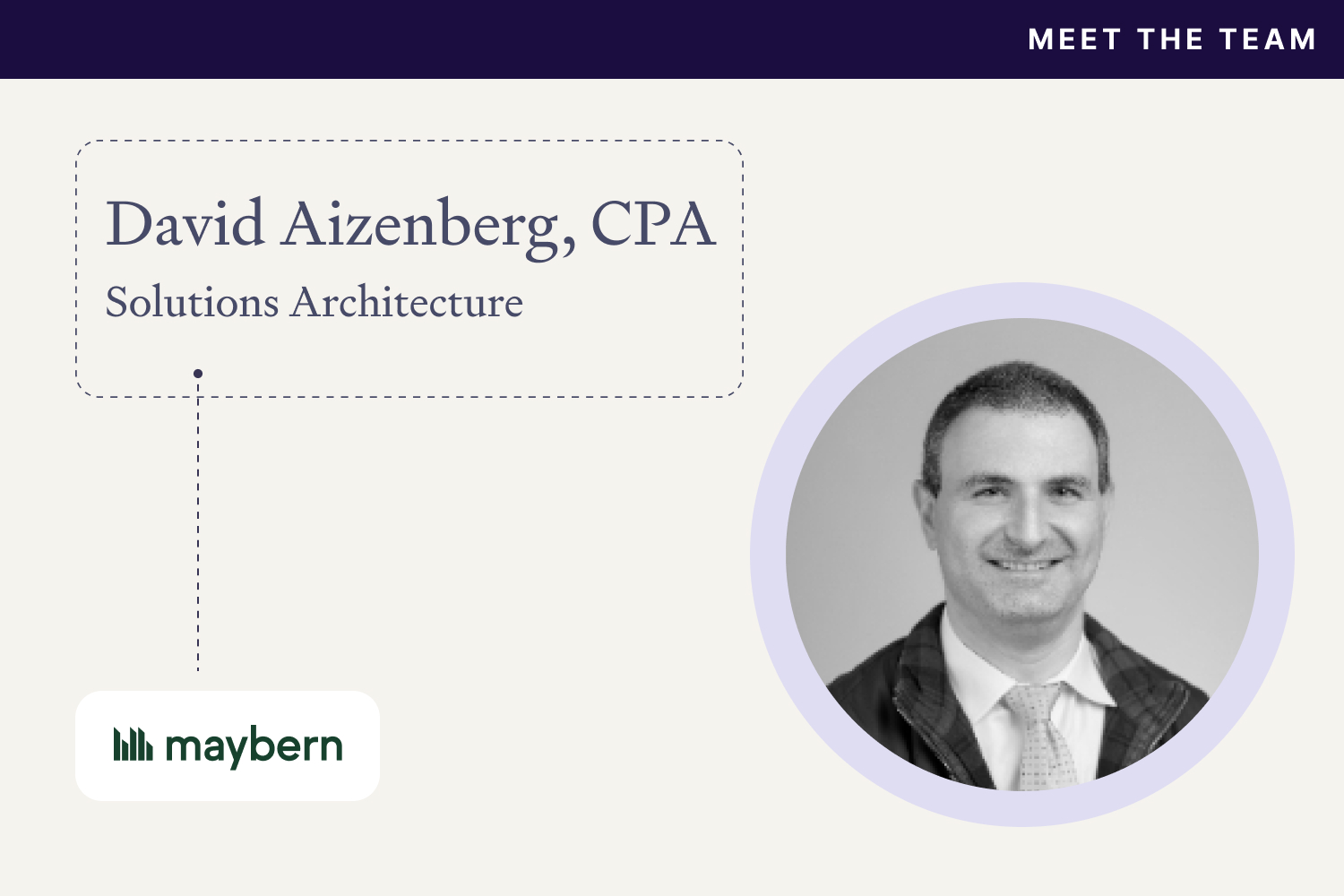
Meet the Team: A Conversation with David Aizenberg, CPA, Solutions Architecture

Welcome to the latest installment of our “Meet the Team” series, where we introduce the talent and expertise driving Maybern’s mission to transform the Office of the CFO from operational management to strategic leadership.
David Aizenberg, CPA, is a Director of Solutions Architecture at Maybern, bringing more than twenty years of experience across investment reporting, fund accounting, system design, and process automation. Before joining Maybern, David spent six years at Kaliber & Co., where he built reporting frameworks, designed reconciliation workflows, led system migrations, and delivered analytics solutions for some of the industry’s most complex portfolios.
David has spent his entire career within financial services and has always been drawn to the space where accounting logic and technology overlap. He believes the best solutions come from understanding both deeply. At Maybern, he is responsible for translating customer workflows and LPA requirements into platform logic, ensuring that even the most nuanced economics can be configured, audited, and scaled. He also collaborates closely with Maybern’s R&D teams, bringing real-world scenarios into the product architecture so the platform supports the full universe of fund structures without relying on custom code.
What brought you to Maybern?
David: Throughout my career, I have seen and built it all: complex Excel models, bespoke Addepar solutions, and countless custom tools to try to handle fund accounting calculations and performance reporting. No matter how well they were designed, the same limitations always resurfaced: they were not scalable, they were hard to audit, and they required extensive tribal knowledge to maintain.
My background as an auditor made this even more frustrating. Audits often rely on materiality thresholds because the underlying calculations are black boxes. You wind up reviewing spreadsheets with buried formulas that no one can fully trace. Relying on data you cannot easily analyze is stressful for everyone involved.
When I first learned what Maybern was building, it immediately clicked. A governed, deterministic system that is queryable and auditable at every layer is an auditor's dream and a fund accountant's lifeline. I realized this was the platform I had been trying to design for years, only much better than I ever could have. Joining the team felt like a chance to help set a new standard for how this industry operates.
What’s one emerging trend in fund finance operations that you think firms ignore at their own risk?
David: Key person risk. Many firms rely on one or two people who manage essential spreadsheets that are massive, fragile, and highly individualized. If that person leaves or steps away, the entire fund can lose operational continuity.
The industry is also facing a shortage of experienced accountants. That puts even more pressure on legacy processes that only a handful of people know how to maintain or explain.
The real risk is not the spreadsheet itself, but the fact that the logic behind it lives in one person’s head. When knowledge sits inside a governed system instead of an individual workflow, teams can operate confidently even as people come and go.
What’s the most complex fund structure or scenario you’ve ever worked on, and what made it challenging?
David: Multi-tiered, multi-hurdle waterfalls. Some agreements include four or five tiers of waterfall logic, with eligibility rules that apply only to certain LPs or in certain circumstances. I have seen structures where one LP is effectively responsible for the carry attributed to another.
Historically, these scenarios result in a web of spreadsheets that drift apart the moment a fund evolves. A minor change in one tier can break the entire model, which leads to hours of validation and constant risk of inconsistency.
At Maybern, we handle this complexity by distilling the economics into modular, reusable components that are configured, not coded. That is the key to reducing risk and creating something that scales.
What’s one piece of accounting logic or LPA clause that still gives people trouble—even experienced professionals?
David: Cashless contributions. The concept is straightforward, but no two partnership agreements describe it the same way. The legal language is often dense, and translating it into clear accounting methodology requires both technical and practical judgment. When firms rely on spreadsheets, the risk compounds. One misinterpretation of language or one incorrect formula can create a chain reaction of errors.
One of Maybern’s biggest strengths is the ability to normalize these complexities. We have seen a wide range of LPAs from many top law firms, which gives us insight into how these mechanics are intended to work. We translate that intent into a consistent, governed framework so clients can operate with accuracy and confidence. You can read more about our simple solution for Cashless Contributions here.
What’s a reporting request from GPs or LPs that would’ve been nearly impossible ten years ago, but is now expected?
David: Granular performance data. LPs expect fund-level, deal-level, and investor-level performance that can be sliced and analyzed instantly. They also expect different metrics calculated in different ways, depending on their internal policies.
Ten years ago, generating even a basic cross-fund return comparison required days or weeks of work. Today, LPs expect it during a meeting. The only way to meet that bar is to have a clean, controlled calculation layer that does not require manual reconstruction every time someone asks a new question.
Which part of Maybern’s product do you wish you’d had earlier in your career, and why?
David: There is so much value to the entire Maybern platform and I wish I had all of it earlier on in my career, but if I had to pick something specific, I wish I had the waterfall engine. I have built and rebuilt more waterfalls in my career than I can count. Even well-designed models are fragile, hard to audit, and nearly impossible to maintain over years of fund evolution.
Maybern’s deterministic waterfall logic provides consistency, transparency, and scalability that spreadsheets simply cannot offer. It would have saved my teams countless hours and eliminated many of the risks we spent our time chasing down.
Frequently asked questions
Quick reference for this topic.
01
02
03
04
05
Recommended Content


AI Sovereignty Is the Future of Fund Alpha

The Maybern MCP is Live
