How AI on top of fund operations actually ships

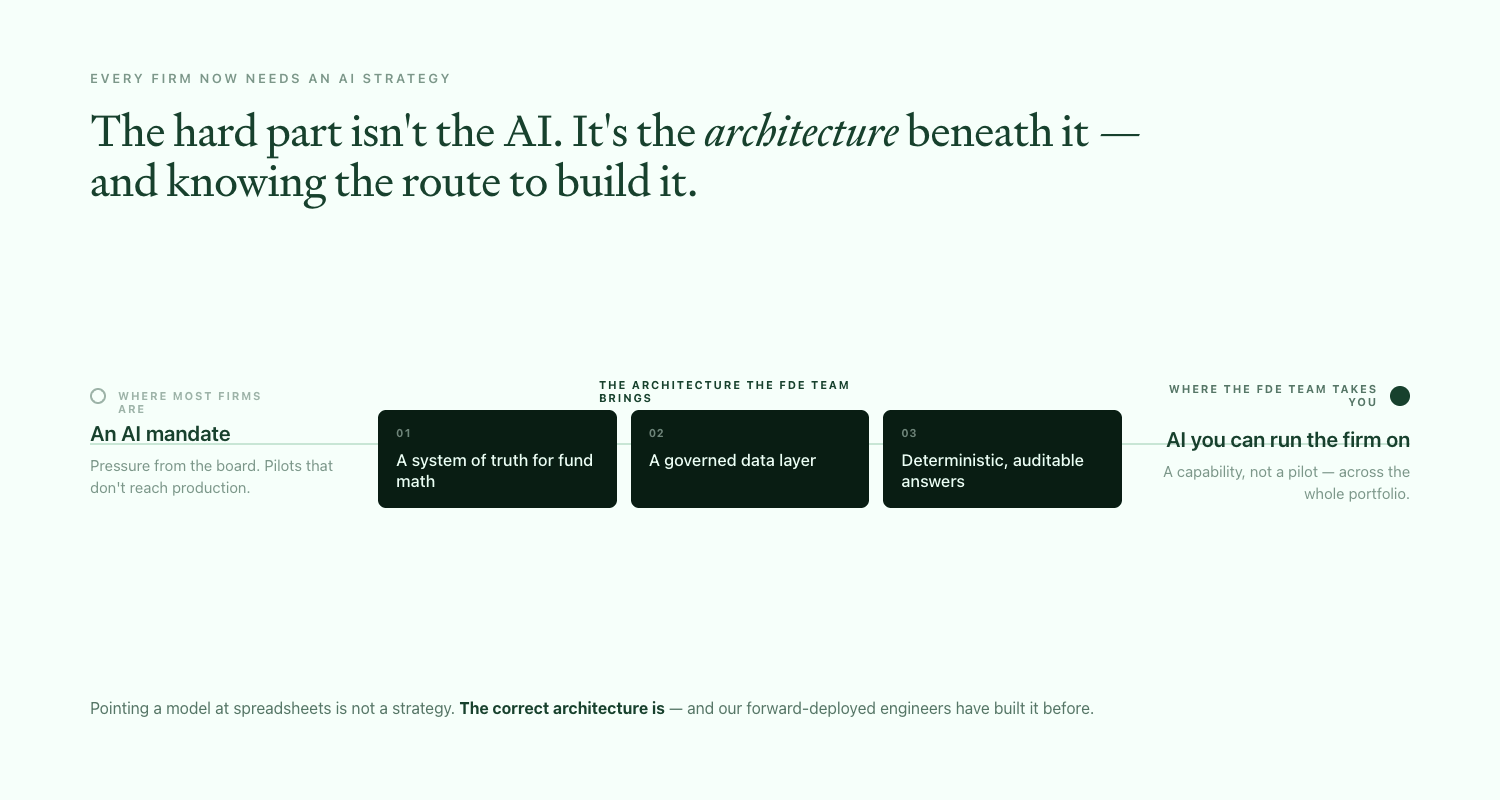
Most AI deployed on fund operations breaks somewhere between the demo and the close. The pattern that survives quarter-end isn't a chatbot bolted onto a workbook stack. It's production engineering on top of governed fund data, run by a team that knows what a waterfall is. Maybern Forward Deployed Engineering is how that work reaches specific firms.
- AI on top of fund operations needs structured fund data with lineage. The workbook stack underneath most GPs can't supply it, and state-of-the-art LLMs debug real Excel files correctly about 12% of the time.
- Buying packaged software on top of a broken data layer doesn't fix the layer. Hiring consultants leaves you with deliverables instead of operating capability.
- Maybern Forward Deployed Engineering pairs production AI engineering with fund-finance fluency, runs on top of the Maybern platform, and delivers agents, evaluators, and runbooks tied to the system of record.
- The default entry point is a short conversation followed by a working session and a 2-week diagnostic. You leave with a written plan you can act on, whether or not you continue.
- The work compounds. Every agent, evaluator, and runbook folds back into the Maybern platform, so your AI investment doesn't fragment across one-off builds.
The packaged-software ceiling
Every fund CFO is being pitched AI. Every one of them knows privately what the pitches don't acknowledge: the data underneath the books is not ready for any of it. The waterfall lives in a workbook one analyst maintains. Side letters live in PDFs and email. NAV reconciliation runs on three sheets nobody documented.
The stakes aren't just operational. The next LP DDQ will ask what your AI strategy actually is, and "we're piloting some things" is the answer a partner doesn't want to give.
The list every fund CFO actually wants includes faster close, better LP responsiveness, and AI on top of the books. All of it needs structured fund data with lineage. The workbook stack can't supply that. Buying more packaged software on top of that stack doesn't fix the underlying problem. Hiring consultants leaves you with deliverables instead of operating capability.
An agent in Excel reads a file. An agent in Maybern reads the model.
State-of-the-art LLMs debug real Excel files correctly about 12% of the time (SpreadsheetBench, NeurIPS 2024). That isn't a model problem. It's a stack problem.
An agent reasoning across dozens of workbooks has to load tens of thousands of cells just to verify a single capital call. By the third formula trace, the model has loaded more than it can reliably attend to. The research community has names for this. Lost in the Middle. Context Rot. The practical effect is simple. AI on top of spreadsheets is a confidence machine, not an audit tool. It produces beautiful wrong answers and presents them like they're correct.
What works instead is a structured representation of the fund itself: waterfalls, carry, capital accounts, ILPA reporting, NAV mechanics, side-letter complexity, encoded once as a model the agent can read. The agent isn't asked to interpret a workbook. The model interprets the inputs deterministically; the agent reasons against the outputs. That's the architecture an audit team can actually sign off on.
Where AI on fund operations actually ships
This is the work of Maybern Forward Deployed Engineering, an embedded team that extends the Maybern platform into the specific complexity each firm runs. Three things differentiate the model from generalist consulting or generic AI/analytics boutiques.
Production AI plus fund-finance fluency. Agent engineers who know what a waterfall is. The team doesn't ask the client to explain ILPA conventions or side-letter mechanics before it can start building. The same engineer who delivers the agent has the board-room presence to walk a CFO through the controls behind it.
Agents, evaluators, and patterns across firms. Every agent, evaluator, and runbook the team builds for one firm informs the next engagement and folds back into the Maybern platform. Custom work hardens the core product underneath it.
Outcome over experiment. The brief is to help a team get to an actual outcome faster. Every engagement runs against a written scope with definitions and AI-output thresholds locked before kickoff. No prompt-and-pray workflows. No multi-quarter science projects. No black-box scores in front of LPs.
Where FDE typically works
The engagement scopes to one operational pain at a time, sized to what's costing the team the most this quarter. The areas where this work compounds the fastest:
- Document workflows. Side letters, LPAs, fee waivers, elections become structured fields. Agents extract; humans approve what's LP-facing or audit-bound.
- Reconciliations. GP books versus admin, custodian, or lender records. Often the first wedge because it's where the workbook stack hurts most.
- Reporting processes. LP reporting, board prep, audit packages, pulled from the same encoded model as the books rather than assembled from scratch each quarter.
- Investment team support. Deal-stage agents, IC memos, underwriting on top of governed data.
- IR operations. DDQ response, capital call narratives, LP Q&A with citations back to source events.
The repeatable pattern across active engagements
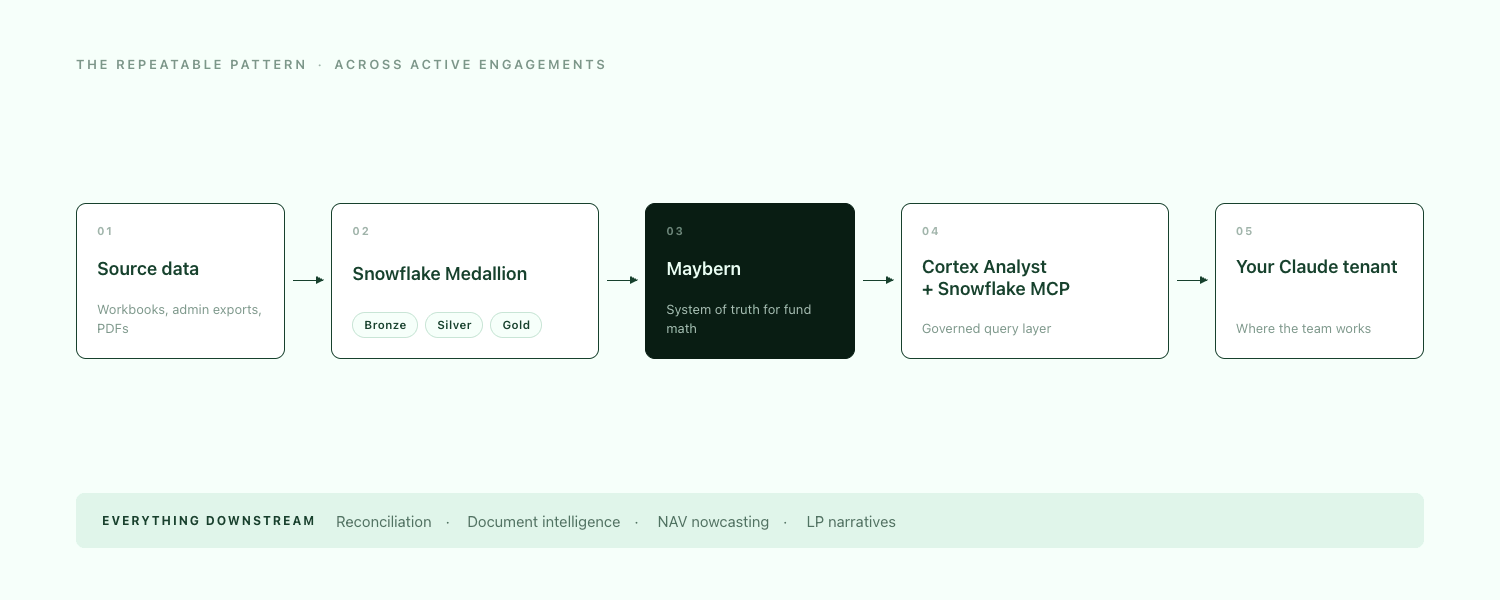
One architecture keeps emerging across the firms we work with. Snowflake medallion architecture (Bronze · Silver · Gold) with Maybern as the system of truth for fund math. Cortex Analyst and the Snowflake MCP wire your Claude tenant to governed data. Everything downstream runs on the same encoded model: reconciliation, document intelligence, NAV nowcasting, LP narratives. The agent layer doesn't have to reason about source-of-truth conflicts, because there is one source of truth.
This is what production AI in private fund finance looks like in practice: a governed model with lineage on every output, with agents that operate against it instead of against the workbook stack underneath.
How a conversation typically becomes a working engagement
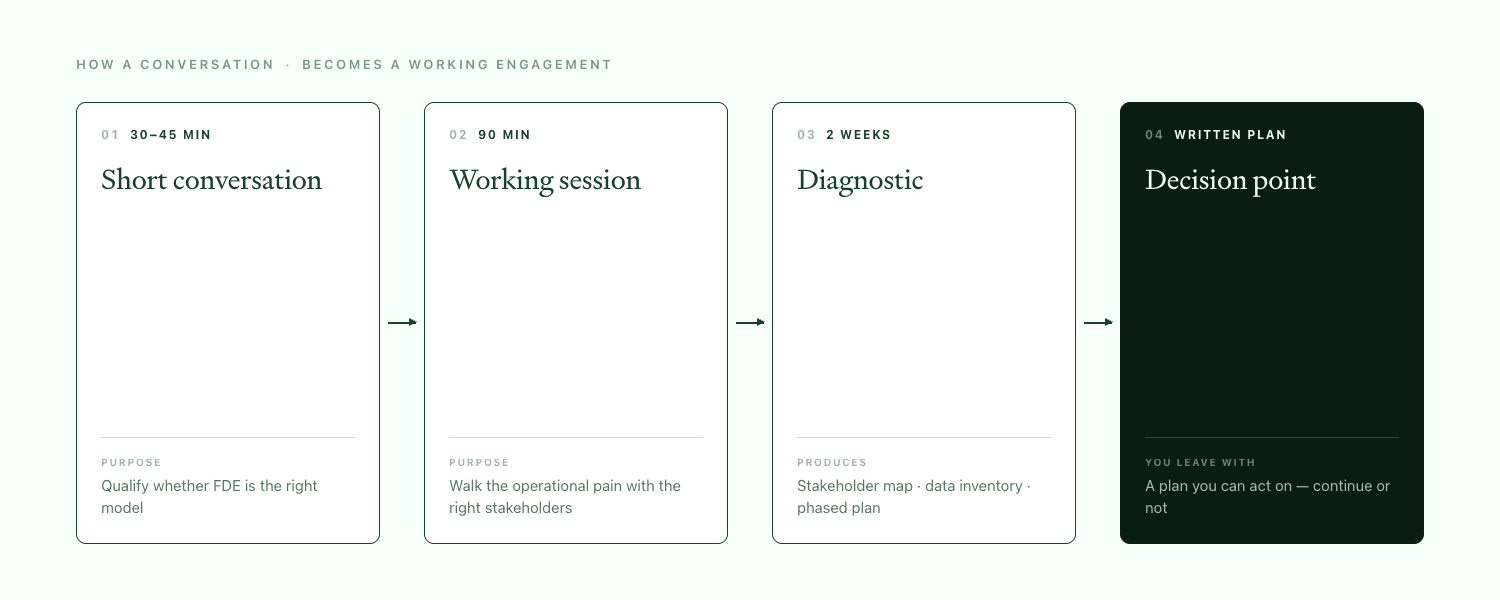
The default entry point isn't a sales meeting. It's a short conversation followed by a working session and a 2-week diagnostic. Short enough to know quickly whether FDE is the right model, structured enough that the client leaves with a written plan they can act on.
Short conversation (30 to 45 minutes). We learn what's highest priority for your team. You learn whether FDE is the right model, or whether the core platform or another path is the better fit.
Working session (90 minutes). The right stakeholders in the room, typically CFO plus technical or control leads. We walk the operational pain point, the data sources behind it, and what an outcome looks like.
2-week diagnostic. Stakeholder map, data and integration inventory, complexity-tier recommendation, phased plan with explicit handoff to the Maybern platform, and a commercial sketch.
Decision point. You leave with a written plan you can act on, whether or not you continue. If you do, the diagnostic translates directly into the engagement. Same team, same code path, no scope reset.
How Maybern approaches this
Maybern is the system of record for fund finance: the encoded model of every commitment, allocation rule, capital event, fee, waterfall, and performance metric, producing the same answer the same way every time. FDE is the embedded team that extends that system into the specific complexity each firm runs. The team inherits the platform's controls (lineage on every transaction, tamper-evident audit records, version-controlled logic, role-enforced maker/checker) rather than rebuilding them.
The objection we hear most often is "we already hired consultants" or "we'll build this internally." The architecture above isn't what a generalist consultancy delivers, and it isn't what a finance team builds in a quarter on top of a chat tool and a spreadsheet. It's what years of fund-accounting engineering looks like, executed against a moving AI standard. That's the build-versus-buy question worth asking.
For the partner reading this. FDE isn't a separate IT track. It's the operational capability that lets your CFO answer in the room, to LPs, to IC, to your auditor, without a science project running in the background. The output of every engagement is something a sponsor can point to in a fundraising deck without translating from engineering. The team inherits the platform's controls (lineage on every transaction, tamper-evident audit records, version-controlled logic, role-enforced maker/checker) rather than rebuilding them.
Architecture, not a chatbot
AI on fund operations isn't a feature you bolt on before the auditor arrives. It's an architecture decision you make at the model layer. Maybern's job is to be the model. FDE's job is to get that model into your firm, with the agents, evaluators, and operating capability your team actually needs, without breaking the system of record underneath it.
If you're trying to figure out what AI for fund operations actually looks like in production, that's the conversation to have.
Frequently asked questions
Quick reference for this topic.
01What's the difference between Maybern's core platform and Maybern Forward Deployed Engineering?
Maybern's core platform is the system of record for fund finance: the encoded model of every commitment, allocation rule, fee, waterfall, and performance metric, producing the same answer every time. Forward Deployed Engineering (FDE) is the embedded team that extends that platform into firm-specific complexity. The platform is the rails; FDE is how those rails reach the operational pain points unique to your fund. FDE always sits on top of the platform; it never substitutes for it.
02How is FDE different from hiring a fund accounting consultancy or a generalist tech FDE team?
A consultancy ships a slide deck and recommendations. A generalist tech FDE team ships engineering but doesn't know what a waterfall is. Maybern FDE pairs production AI engineering with fund-finance fluency, and the work compounds. Every agent, evaluator, and runbook we build folds back into the Maybern platform. Custom work hardens the core product instead of fragmenting your stack.
03What does the working session plus 2-week diagnostic actually deliver?
A short conversation (30 to 45 min) qualifies whether FDE is the right model. A 90-minute working session walks the operational pain with the right stakeholders. The 2-week diagnostic produces a written stakeholder map, data and integration inventory, complexity-tier recommendation, phased plan with explicit handoff to the Maybern platform, and a commercial sketch. You leave with a plan you can act on whether or not you continue.
04Where does FDE typically focus first in a new engagement?
The most common wedges are reconciliations (GP books versus admin, custodian, or lender records), document workflows (side letters, LPAs, fee waivers), and reporting processes (LP reporting, board prep, audit packages). The team scopes to one operational pain at a time, sized to what's costing the team the most this quarter. Pain selection is a decision the working session makes, not a default.
05Why do AI agents need to run on a structured fund model rather than on top of Excel?
State-of-the-art LLMs debug real Excel files correctly about 12% of the time (SpreadsheetBench, NeurIPS 2024). An agent reasoning across dozens of workbooks loads tens of thousands of cells just to verify one capital call, more than the model can reliably attend to. A structured fund model lets the agent reason against deterministic outputs rather than interpret cell soup. That's the difference between a confidence machine and an audit-ready system.
Recommended Content

Shipped in Maybern: a fund agent, MCP and reconciliation


AI Sovereignty Is the Future of Fund Alpha
